As the Republicans prepare for their first-ever national convention to take place in New York City, are they struggling to come up with a welcoming committee of native New Yorkers? Surely, Republican Governor George Pataki will play a part, but what about Republicans specifically from the city? It is true that for almost 10 years New York City's mayor has been a Republican, but both Rudy Giuliani and Michael Bloomberg used to be Democrats, and they won election in part because they were willing to abandon many now-core national GOP positions, including banning abortion and not granting gay people full equality.
The convention could easily give a primetime slot to every Republican elected official from New York City. There are only 13 of them. That includes all three levels of government, federal, state and city:
- Only three of the 51 New York City Council members are Republican.
- Only two of the 65 State Assembly members are Republican.
- Only four of the 25 State Senators whose districts are completely in New York City, are Republican. (Add to that Guy Vellela, who represents a very gerrymandered district that corralled white voters in the Bronx and Westchester County into a district that looks like a white donut around a black center).
- Only one Congressional seat out of the 14 that include New York is represented by a Republican.
(To get to 13, add the borough president and district attorney from Staten Island).
And even most of these GOP office-holders do not represent Republican-majority districts.
Where Do Republicans Live In NYC?
The small number of Republican elected officials is not surprising. Only 13 percent of the 3.7 million registered voters in New York City are registered as Republican, according to the New York City Board of Elections.
The smallest percentage of Republicans is in the Bronx (9.3 percent). Listing the other boroughs in ascending order, they are:
- Brooklyn (12.1 percent)
- Manhattan (14.1 percent)
- Queens (18.1 percent)
By far the largest percentage of Republicans is in Staten Island (37.8 percent). Only in Staten Island are there contiguous areas of Republican strength, as evident in the accompanying map showing the concentration of GOP voters throughout New York City.
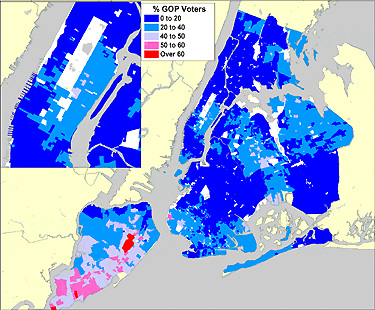
Todt Hill, an affluent area of single-family homes, contains the most Republican-majority election districts in the city. The extended area around Todt is also reliably Republican, responsible for electing five of the 13 GOP public officials in the city (a state senator, two assembly members and two council members).
No other area in NYC is so pervasively Republican, not even the Upper East Side. Indeed, even in that affluent enclave (where four years ago zip code 10021 supplied the most campaign funds to both Bush and Gore of any zip code in the United States), Democrats outnumber Republicans.
In Queens there are a few pockets of Republican strength in Glendale, Middle Village, Forest Hills, and Howard Beach as well as Douglaston, Whitestone, and College Point. There are two GOP State Senators and one council member from Queens.
Election districts in New York City with high proportions of GOP enrolled voters, are areas with high proportions of whites living in owner-occupied homes.
How Different are NYC’s GOP Voters from Other NYC Voters?
Republicans in New York City are demographically different from other city adult residents.
GOP members are much more affluent. About 31 percent of them have incomes above $75,000. This compares to only 16 percent of New Yorkers as a whole, according to an analysis of the raw data from a CBS-New York Times poll of New York City completed in June 2003. (Because the number of respondents is only 962, the results reported are approximate.)
Republicans are about half as likely to report that their financial situation has worsened recently--24 percent of Republicans say that, compare to 42 percent of all New Yorkers.
Republicans are more likely to own their own home (47 percent versus 30 percent.)
About three-quarters are white compared to less than half of the rest of the New York City population. Interestingly, though, there is as large a proportion of Republicans who are Hispanic (28 percent) as of New Yorkers in general.
Republicans are more likely to be between 45 and 64 years old than the population as a whole (37 percent versus 27 percent.), and just about as likely as the population as a whole to have kids living with them (35 percent.)
They are more like to identify with a religion, 81 percent compared to 76 percent. While 57 percent of New York City Republicans are Catholic, only 36 percent of non-Republican New Yorkers are Catholic; similarly 14 percent of Republicans they are Jewish compared to 8 percent of the rest of New Yorkers.
But Republicans in New York are just about as likely to be in a union or have a union member in the family--26 percent versus 25 percent -- and even more likely to have a municipal worker in the family--25 percent versus 17 percent.
And Republicans are more likely to smoke -- 29 percent versus 19 percent.
Andrew A. Beveridge has taught sociology at Queens College since 1981, done demographic analyses for the New York Times since 1993, and provides expert testimony on a range of cases, including housing discrimination. The opinions expressed are his alone.