ORGS
NYC Government
NYS Government
US Government
Advocates
BIDs
Civics
Culture
Foundations
History
Labor
Public/Private
Think Tanks
BOROS
Bronx
Brooklyn
Manhattan
Queens
Staten Island
News Sites
Daily News
NY Times
Daily News
NY Post
Newsday
New York Sun
NYC Weeklies
Amsterdam News
City Limits Weekly
Crain's New York Business
Gay City News
New York Magazine
New York Observer
New Yorker, The
Time Out New York
Village Voice
Dailies, Weeklies, Monthlies, etc. »
Other-Language Press
NYC Blogs »
Uneven Allotment of Parking Near Schools
A number of smaller schools have more parking spaces than those with larger staffs.
City Slashes Teacher Parking Permits
Bloomberg Says City Should Look at No-Car Parks
As bicycle activists prepare to press Mayor Bloomberg to ban cars from Prospect Park, the mayor said yesterday that the city should look at the proposal and added: "It would be great if we could keep cars out of all parks."
Enjoying the Danger on the Broadway Esplanade
While the new esplanade along Broadway in Midtown seems to have become an instant hit with office workers and tourists, many worry about being hit bycars and trucks.
Money for Transit Systems to Increase
Transportation Alternatives
How Parking Requirements Lead to More Driving
MTA Subsidies Flat
The Value of Street Life
Grading the Subways
by Clifton Hood
New York: The Politics of Urban Regional Development
by Michael N. Danielson and Jameson W. Doig
The Power Broker: Robert Moses and the Fall of New York
by Robert A. Caro
Tunneling to the Future: The Story of the Great Subway Expansion That Saved New York
by Peter Derrick
Urban Transportation Systems: Choices for Communities
by Sigurd Grava
Transportation Bond Act
by Bruce Schaller
October 2005
With mayoral candidates giving little attention to transportation issues, voters' biggest choice in the transportation arena will be their vote on the 2005 Transportation Bond Act. The bond act, approved by the Legislature this spring as part of a 5-year, $36 billion capital plan, would authorize $2.9 billion in state-backed borrowing for transportation, to be repaid through general revenues. One-half of the bond act funds would be dedicated to public transportation in New York City and its suburbs. Projects to be funded include:
• $450 million to move ahead with the Second Avenue Subway
• $450 million for the East Side Access project, connecting the Long Island Rail
Road to Grand Central Terminal;
• $100 million for a rail link between lower Manhattan and Kennedy airport;
• $115 million for purchase of new subway and commuter railroad cars;
• $90 million for new buses; and
• $161 million for track replacement and tunnel lighting. An additional $235 million is set aside for upstate public transportation systems.
Although many people think of New York City as synonymous with transit and upstate as synonymous with highway spending, in fact, a substantial amount of statewide highway spending goes to New York City projects. Twenty-three percent of the bond's highway funding will be spent in the city. New York City highway projects (In PDF Format) include:
• $81 million for Kew Gardens Interchange/Van Wyck Expressway Improvements;
• $30 million for closed circuit television cameras, electronic message signs, vehicle detection devices and highway advisory radio on the FDR Drive and Henry Hudson Parkway;
• $23 million for Henry Hudson Parkway Rehabilitation;
• $25 million for West Shore Expressway Access and Safety Improvements;
• $19 million for the Bronx River Greenway; and
• $11 million for Long
Island Railroad Bridge Upgrades to allow heavier, larger rail cars to access
the Brooklyn, Queens and Long Island market areas.
Bond act spending also aims to maintain the percentage of state highway bridges in New York City that are rated as in good or excellent condition and slightly improve the proportion of interstate highway lane mileage in New York City that is rated as in good or excellent condition.
No one seriously disputes the importance of maintaining and upgrading the state's transportation system. The Bond Act has thus attracted a long list of supporters including Governor George Pataki, Attorney General Eliot Spitzer, State Comptroller Alan Hevesi, and transit advocacy, environmental and civic groups, including the NYPIRG Straphangers Campaign and the New York Public Transit Association. Both Mayor Michael Bloomberg and his opponent, Fernando Ferrer, support the bond act.
Supporters say that the Transportation Bond Act funds are vital to maintaining the state's sprawling and aging transportation infrastructure. The funding is also critical to construction of the Second Avenue Subway and East Side Access -- projects long discussed and planned but only now garnering the necessary funding. As much as $4 billion in federal funding is contingent on the bond act passing since the federal government evaluates projects on the level of local financial support. Supporters also point out that bond act spending will create construction jobs in the short term and spur economic growth for years to come.
The bond act has also attracted opposition, primarily from groups that feel the state already has too much debt. The Citizens Budget Commission (In PDF Format) says that the state is poised to take on $19 billion in new debt in the next five years. Only the $2.9 billion in the bond act requires voter approval, however. The budget commission argues that voters should reject the bond act as the only way to say no to the overall growth in borrowing.
The Automobile Club of New York also urges voters to reject the Transportation Bond Act. The Auto Club criticizes the state for raiding the highway trust fund, whose revenues come from the gas tax and auto registration fees. The Auto Club says that the state has used trust fund revenues to plug general budget shortfalls. The Auto Club argues that instead of borrowing to pay for transportation improvements, the integrity of the trust fund should be maintained and used for these projects.
Supporters reply that the real choice -- aside from underfunding transportation -- is between state-backed borrowing and borrowing that would be paid back through transit fares. They point out that after the 2000 Bond Act failed, the Metropolitan Transportation Authority borrowed heavily, leading to two fare increases since then.
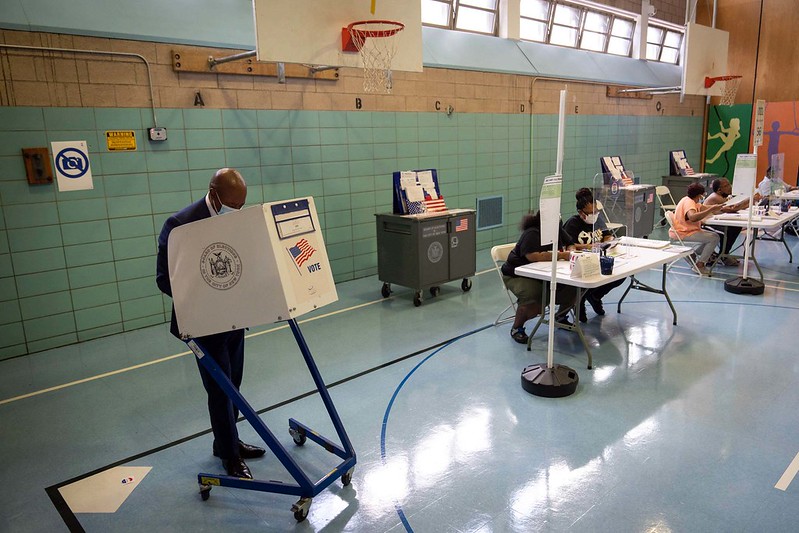
In 2000, a $3.8 billion Transportation Bond Act narrowly failed to win voter approval. Prospects for this year's proposal are uncertain. A recent Quinnipiac University poll found voters statewide supporting the measure by a 56 percent to 36 percent margin. New York City voters supported it by 67 to 26 percent and suburban voters by 60 to 32 percent. Upstate voters were about evenly split.
While encouraging to supporters, these poll numbers also provide reason for caution because polls before the 2000 election also showed a majority in support. On election day, many New York City voters "who would be expected to vote favorably" overlooked the proposition in the lower right corner of the ballot. In fact, had the dropoff from the presidential vote to the bond act vote been the same downstate as upstate in 2000, the measure would have passed.
Supporters are aiming to heed the lessons of 2000. A group of business and building associations has funded a statewide Vote Yes for Transportation campaign. The $1.5 million campaign will include door to door canvassing and upstate radio ads.
Supporters have also moved to shore up support on Staten Island. The MTA recently shifted funds to build a third MTA bus depot on the island after the borough president, James Molinaro, criticized the measure.
Chances for passage of the 2005 Bond Act appear to be better than the 2000 measure, which failed narrowly, but are not assured. Voters thus have an important and very real choice to make on November 8.
Bruce Schaller, who has been in charge of the transportation topic page since its inception in 1999, is head of Schaller Consulting, which provides research and analysis about transportation. He is also a Visiting Scholar at the Rudin Center for Transportation Policy and Management at New York University.
Other Related Articles:
Transportation Bond Act's Passage May Bring Other Transit Issues To The Fore (2005-11-11)
The Ballot Questions (2005-11-07)
The Transportation Bond Act: Vote Yes (2005-10-17)
The Transportation Bond Act: Vote No (2005-10-17)
Election Special--The Transportation Bond Act (2000-10-01)
React to this article on our Transportation Message Board.
Visit the complete Topic Archives
Sites of Interest from Collegester:
Online Casino |
Wireless broadband |
Place
Your Link Here!