Vanessa David was happy working for the Department of Education, delivering sheetrock and other construction material to school construction sites. But after nine months on the job her supervisor fired her. David believed she was discriminated against, as a woman, an African-American, and as a lesbian, and so she filed a complaint with the City Human Rights Commission.
That was almost seven years ago. The complaint went nowhere, at one point commission staff telling her that it would be difficult to prove discrimination, even though she had been the only woman among 45 employees at the Division of Trucking, and only one of three African-Americans. “Certain trades belong to the Irish, some to the Italians,” she recalled being told.
“Even with the support of my union, my supervisor still has his job, the commission still isn’t investigating my case, and I probably have a three-year court battle left,” she said earlier this year at a City Council hearing in support of a proposed new anti-discrimination law, Intro 512-A. “I believe that Intro 512 could have prevented many of these problems.”
The bill, which is called the Human Rights in Government Operations Audit Law (or Human Rights GOAL), is intended to “stop discrimination before it happens” according to its supporters at a coalition named the New York City Human Rights Initiative.
“We need to anticipate discrimination before it becomes a legal matter and harmful,” said outgoing Councilmember Bill Perkins, the bill’s chief sponsor.
“We know there are inequalities in city employment and services,” said Barbara Schulman of the Urban Justice Center’s Human Rights Project, a leader in the initiative. “They are not the product of malicious intentional decisions to exclude or neglect particular groups,” but of “habit, of conducting business as usual, and of insufficient avenues for input from those affected by policy.”
Betty Powell, a veteran Brooklyn-based diversity trainer, testified in April that the law would require us “to look with unblinking candor at all our city agencies’ programs and policies, employment practices, budget allocations, service deliveries, etc. [and] ascertain through audit and analysis, not whether or not, but how the racial and gender gaps show up in our city’s work and workplaces, and then rigorously support historically unparalleled, proactive structural solutions.”
As former Mayor David Dinkins testified at that same hearing, the law could prevent many discrimination lawsuits against city agencies, and thus save tax dollars, by “identifying potentially harmful policies in advance” rather than provide “redress for discrimination after the fact,” as the city’s current Human Rights Law does.
The bill has 32 co-sponsors in the City Council, including outgoing Speaker Gifford Miller. But advocates say that Miller’s support has been tepid, and the Bloomberg administration opposed an earlier version of the bill. The offices of both Miller and Bloomberg say they are now “reviewing” a new draft of it.
Anthony Crowell, special counsel to the mayor, testified that the administration supported many of the goals of the proposed legislation, but had a problem with its language, which ignores, he said, “the real progress we have already made” in preventing discrimination, declines to “adopt a realistic approach to governing,” and makes everything mandatory. “These mandates are so broad, and so vague, that they would cause endless disputes over their intent and bureaucratic confusion.”
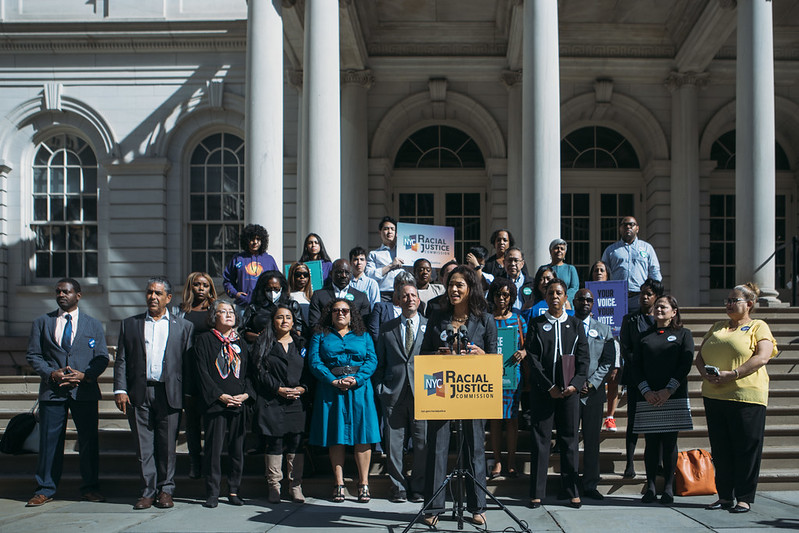
To push the legislation along, its supporters held a rally/press conference on the steps of City Hall shortly before Election Day, participants holding up signs with big red lips on them and the words: “Real Solutions, Not Lip Service.”
“We hear all the time how diverse the city is,” Craig Gurian, director of the Anti-Discrimination Center of Metro New York , said at the October rally, “but New York City and the New York metropolitan area remain among the most segregated places in the nation.” It is in the city’s “self interest,” given the millions it pays out in discrimination suits annually. “Any sensible entity--whether it’s a hospital, a corporation, or even a municipality -- always needs to be taking risk reduction steps.”
The proposed legislation tries to make the city apply international human rights law, particularly the Convention on the Elimination of Discrimination Against Women , signed by the United States in 1980 but not ratified by the Senate, and the Convention on the Elimination of All Forms of Racial Discrimination , which was ratified. This bill goes further, mandating that all city agencies take a proactive approach to monitoring inequities and preventing discrimination by educating the staff and public about its provisions, conducting audits of compliance and developing action plans in response, and seeking the input of the city’s diverse communities in doing so.
Under the bill, a newly-created eight-member Human Rights Task Force, appointed by the mayor, would be charged with implementing the law. The Commissioners of Citywide Administrative Services and Human Rights would serve ex officio along with the Chair of the Equal Employment Practices Commission. The law would also create a 13-member Human Rights Advisory Committee, including the comptroller, public advocate, appointees of the five borough presidents, five members appointed by the City Council, and a chair picked by the mayor with the council’s advice and consent. This committee’s function would be “to advise on the guidelines and procedures” used by the Human Rights Task Force.
Ejim Dike, a leader of the Initiative, said, “Race, gender, sexual orientation, and neighborhood determine whether you get services, health insurance, and how long you will live.” She believes that evident disparities require the new medicine of this legislation.
Andy Humm, a former member of the City Commission on Human Rights, has been in charge of the civil rights topic page since its inception in 2001. He is co-host of the weekly "Gay USA" on Manhattan Neighborhood Network (34 on Time-Warner; 107 on RCN) on Thursdays at 11 PM. Â