As the Passion of the Christ continues to break box office records, Christians observe lent, Jews prepare for Passover, the attorney general holds morning prayer services and politicians routinely voice their religious conviction from the stump, one might get the impression that Americans are becoming more and more religious, and that they are increasingly uneasy about such secular and scientific trends as abortion, equality for gay people, and stem cell research. Yet, data from the 2001 American Religious Identification Survey shows that Americans, and New Yorkers, are actually becoming less religious. About 30 million adults were found to have no religious affiliation, which is almost double what it was a decade earlier (from 8.2 to 14.1 percent). In New York State, there are about 1.9 million such residents (or about 13.4 percent of the population), and in New York City, we can infer, some 14 percent of the population says it has no religious affiliation, which, again, is about double what it was a decade ago.
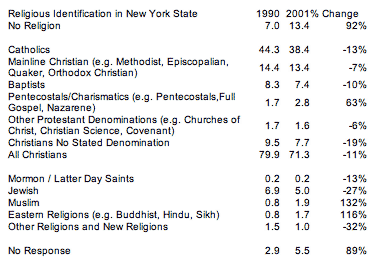
The survey results for New York State, presented in the accompanying table present few other surprises. Together all Christian groups have declined, from 80 percent to 71 percent. Most Catholic and Protestant groups, along with the Mormons and the Jews, report substantial drops in religious identification, while Muslims and Eastern religions more than doubled their adherents. Those few subscribing to the more evangelical and fundamentalist versions of Christianity also show substantial increases in New York. Apparently, the non-Christian religions of the immigrant communities and those of the Christian right are on the upsurge, but the more conventional religions are losing popularity. At the same time, though, as I said, there is a gain in people having no religion at all.
Unlike those in the United Kingdom and some other countries, the United States Census does not ask for religious identification. To fill that gap, academic researchers in 1990 and again in 2001 were able to raise funds to carry out a large scale nationwide survey of religious identification. In 1990, for the first time ever, they surveyed over 110,000 US adults about their religious identification. Results from the National Survey of Religious Identification were reported in the seminal book One Nation Under God: Religion in Contemporary America by Barry Kosmin and Seymour Lachman. In 2001, Kosmin along with Ariela Keysar and the late Egon Mayer of the CUNY Graduate Center conducted a survey of about 51,000 adults from the lower 48 states. That study produced two reports, and now the researchers are working on a book interpreting their findings. Since the United States does not track religion as part of the census, the results from these surveys give us the best information available on the changing patterns of religious identification. Both surveys used individual responses to questions to measure religious identification.
The increase in religious identification in New York among Muslims, and those from Eastern religions, reflects the increase in the number of immigrants from Asian and Middle Eastern countries. What is much more difficult to account for is the large increase in those stating that they have no religion. While some of the growth is among those who say they are atheist or agnostic, the vast bulk of those giving a "no religion" response do not identify with such labels. Those having no religion tend to be white, unmarried, young and male.
Some researchers cite growing evidence, that America and New York City are truly becoming a belief bazaar, where people essentially pick and choose among competing viewpoints, including no religion at all. In a more detailed survey among 17,000 respondents, ARIS results found that about one-sixth of the adult population had switched religions. The report notes, "switching has involved not only the shift of people's spiritual loyalties from one religion to another -- which could reflect some kind of spiritual seeking -- but also and perhaps more importantly, a dropping out of religion altogether." Overall about one-fifth of those with no religion switched to that view from an established religion, while only five percent of those with no religion found religion.
The data for New York and for the nation make it plain that, despite the visibility of the few, for a large segment of the population, conventional religion is losing its appeal.
Andrew A. Beveridge has taught sociology at Queens College since 1981, done demographic analyses for the New York Times since 1993, and provides expert testimony on a range of cases, including housing discrimination. The opinions expressed are his alone.