After years of expensive education,
a car full of books and anticipation,
I’m an expert on Shakespeare and that’s a hell - a lot
but the world don't need scholars as much as I thought.
Jamie Collum’s “Twentysomething,” a wry anthem of the newly graduated, describes the fate of many of New York City’s twentysomethings better than some of the rosy pronouncements heard recently. While USA Today and others claim that this is a banner year for graduates, the good news mainly applies to students in several specialty fields, such as business, engineering, computer science and nursing. And the gains are more pronounced among recent graduates of prestige universities.
While young people with bachelor’s degrees in business, accounting and engineering command salaries of about $50,000, most of this year’s liberal arts graduates will see a salary of about $31,000 -- similar to the pay received by a starting public-school teacher. This represents a decline of 1 percent since last year.
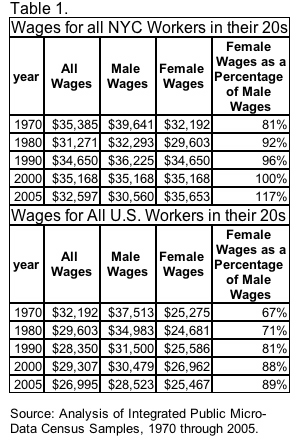
For those with all levels of education, including college and beyond, wages today have yet to catch up with the “real” wages (in other words, adjusted for inflation) that twentysomethings received in 1970. Men have seen their real wages fall substantially and women outside of New York have seen only very modest gain. Table 1 presents median wage figures, taken from Census data, for all full-time workers in their 20s from 1970 through 2005. Wages for all twentysomethings in New York City and in the United States are still below those received in 1970.
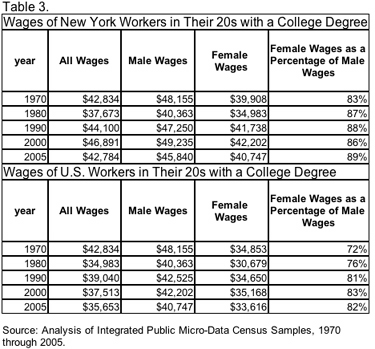
Over this period, women in New York City saw an amazing jump in their wages compared with those of men in their age group. While women in the city earned, on average about $7,000 less than men in 1970, by 2005 they made about $5,000 more. Interestingly, women in the country as a whole have closed the gap between their earning and those of men, but still lag behind.
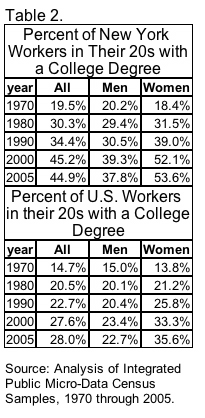 At the same time, as Table 2 shows, women eclipsed men in the proportion who were at least college educated by 1980. In New York City, over 53 percent of working women in their twenties have at least a college education compared to about 38 percent for men. Although working women in their 20s across the country are much more highly educated than are men, women in New York City, particularly those in Manhattan, are much more likely to be single, earn more money, and have more education than women living in the rest of the United States.
The data show a number of other striking trends:
• For college graduate males, wages have declined in New York City and nationally, while women have had very modest gains in the city, but not in the U.S.
• For those with advanced levels of education (beyond a bachelors degree), wages of females have soared in NYC, while male wages have only crept up. Nationally, male wages have fallen, while female wages have stood still.
• For the college and even better educated, the wage gap between men and women declined, but it is still much smaller in New York City than nationally.
Furthermore, the gap between the wages of the most highly paid and the least highly paid of the college graduates in their 20s increased, as well. In 1970, those in the top quarter made at least $53,476. By 2005 that figure grew to $61,120. But those in the bottom quarter, who in 1970 made at most $35,917, saw their wages drop to $35,560 by 2005. So even among the young, affluent New Yorkers are becoming even more affluent, while the less affluent are not even holding their own. For those with education beyond college, the pattern is very similar: Those in the top quarter in 2005 made at least $77,419 up from $67,577, while those in bottom quarter made no more than $42,784 only slightly more than $41,504, the amount that they made in 1970.
In short, the lyric of Collum’s “Twentysomething” hits the mark for many in New York City as the picture is far from cheerful. But they have some consolation. If young males with a college or better education in New York City and the United States have seen their wages decline, those without college are much worse off. It may not better today than it was 35 years ago to be a college graduate twentysomething, but it is certainly better than being a twentysomething without a college degree.
Andrew A. Beveridge has taught sociology at Queens College since 1981, done demographic analyses for the New York Times since 1993, and been in charge of Gotham Gazette's demographics topic page since 2000. The opinions expressed are his alone.