Joseph Endico doesn't remember the sound of the rope snapping. He doesn't remember seeing his harness give way, or feeling his head hit the ledge of the window as he fell three stories from the collapsing scaffolding onto the grass below.
"I remember waking up on the ground a little while later with a towel on my head, and people saying, 'you're going to be okay,'" Endico recalled recently, the scar from the metal staples used to close his wound still visible on his shaved head 19 months later.
Endico did survive and discussed the accident matter-of-factly as he sat in his lawyer's office last week. But he is not okay. Still unable to return to his job, Endico is living off of workers compensation, with the help of his family.
He says he had never heard of another scaffolding accident before his own, but that since his fall he notices them everywhere. Its not just scaffolding: The most recent statistics count 29 construction related deaths in the city in the year leading up to September 30, 2006, a 60 percent increase from the 18 deaths the year before.
In recent weeks public officials have taken several steps responding to issues of workplace safety. Councilmember Erik Martin Dilan introduced three bills specifically related to scaffolding safety, following up on a mayoral taskforce. Governor Eliot Spitzer, meanwhile, announced a plan to reform workers compensation so that it better serves both injured workers and their employers, a balance that has evaded state policymakers for years.
MORE CONSTRUCTION, MORE DANGER
New York City's construction industry has become increasingly dangerous as the city experiences an unprecedented building boom. The city is issuing residential building permits at near record numbers, and huge projects are being planned and constructed around the city. (See slide show.) About 123,000 New Yorkers work in construction, according to the New York Building Council, and the number of construction jobs is increasing so rapidly that employers worry about finding enough workers to fill them.
As the industry expands, its composition is changing. About half of the construction workers in the city are immigrants, and over one-quarter are not proficient in English. 75 percent of New York's construction jobs remain unionized, four to five times the national average. But with so much construction going on, the number of smaller non-union employers is growing.
It is non-unionized immigrants working on smaller jobs who are being injured in disproportionate numbers. Over half of the deaths over the most recent year involved companies with fewer than 10 workers, and almost three quarters of those killed were immigrants or workers with limited proficiency in English.
Unionized employers take this as a sign that their fly-by-night counterparts working smaller jobs should be subject to stricter regulations. Larger construction sites are subject to more stringent safety regulations. Any construction project with buildings over 14 stories tall must keep a site safety coordinator on site at all times, for instance, and companies building scaffolding over 40 feet tall must apply for a building permit. Lou Coletti, head of the Building Trades Employers' Association, an organization that represents union employers building large projects, says that city officials would do best to extend safety requirements to smaller, non-union employers.
"We know our members do it because we invest $50 million a year," he said. "The non-union sector invests nothing."
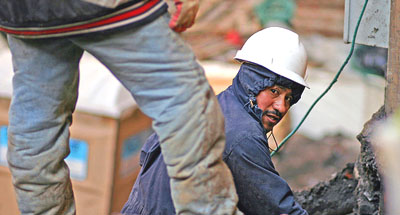
Non-union immigrant workers are at the highest level of risk
SAFER SCAFFOLDING
Construction is a dangerous job, and workers at or below street level are hardly immune to danger. A construction firm on Staten Island, for instance, pleaded guilty to negligent homicide last month after one of its workers was buried when the trench he was working in collapsed. But city officials are paying special attention to falls, particularly those relatd to scaffolding.
Falls are the most common cause of construction deaths in New York. Locally, such deaths rose from nine to 17 over the last year. When Mayor Michael Bloomberg planned City Hall's response to the increase in construction deaths, his first target was hanging scaffolding. His administration formed a task force to establish tougher regulations and has adopted the recommendations it made in December.
Acting on these recommendations, the mayor has included $4 million in his budget for the upcoming year to create a scaffolding safety unit in the buildings department with 10 new inspectors to enforce existing safety regulations. Another $2 million will be used for training and outreach in Spanish, Chinese, Polish, Russian, and Urdu.
Councilmember Dilan, a member of the task force, introduced three bills that would make several aspects of its recommendations city law. They would require construction firms to notify the buildings department when they plan to use C-Hook scaffolding, a type of hanging scaffolding involved in over half of the scaffolding deaths in 2006. His bills would also increase fines for violators, and require daily written inspections of scaffolding by site supervisors.
The mayor also called on the federal government to increase its investment in local Occupational Health and Safety Administration inspectors. This echoes criticism from worker advocates who blame the lax approach of Bush administration for the fact that 2004 was the first year in a decade in which the nationwide workplace fatality rate actually rose. In its first five years in office, the administration "failed to issue any significant safety and health rules, compiling the worst record on safety and health issues in [Occupational Safety and Health Administration] history," according to the AFL-CIO report Death On The Job.
New York State fares better than most others, ranking ninth best in terms of worker fatality rates and imposing harsher fees on violators. Even so, the AFL-CIO calculates that if federal inspectors in New York continue their work the current rate, it would take 99 years for them to visit each workplace once.
Joel Shufro, executive director of the non-profit advocacy group New York Committee for Occupational Safety and a member of the task force, doubts Bloomberg's calls for help from Washington will change this.
"[The mayor] would have to be demanding a different administration with a different philosophy of enforcement," said Shufro. "This one, in terms of safety on the job, is bankrupt."
AFTER THE FALL
Even for construction workers who survive, accidents on the job often change their lives forever. Joseph Endico had been working on construction sites for decades, and on scaffolding almost daily for the three years leading up to the morning of June 24, 2004, when he was asked to help install rubber waterproofing on the third story of an apartment complex. There was a harness waiting for him on the scaffolding as well as a rope grab, which serves as a backup if the harness fails. He put them on.
During the part of the morning that Endico doesn't remember, one of the frayed ropes holding up the scaffold he was standing on gave way. His harness and rope grab failed in succession, and he fell three stories, hitting his head on the way down.
The fall left him with a concussion, as well as serious injuries to his back and neck. After a night in the hospital and six weeks at home in bed, Endico started a physical therapy regimen that continues today. He recently had surgery on his shoulder.
The benefits that workers like Endico are entitled to, and what legal recourse they can take against their employers, have been perennial sources of tension at the state level, where much of the regulations regarding injured workers are written.
Today, Endico's only income is workers compensation, a benefit that he will continue to receive as long as he is unable to work. Workers advocates and employers alike have long complained about the state's program. The $400 Endico receives weekly is the maximum benefit, even though in his case it is about half his previous salary and does not include health insurance. Despite the relatively meager payouts, employers put more money into the program than almost anywhere else in the country.
Bit despite such failings, changing workers compensation has long been bogged down in Albany. On the last day of February, however, Governor Eliot Spitzer announced a deal on workers compensation that he and other state officials brokered with labor and business leaders. The agreement increases the maximum benefit to injured workers, but caps the amount of time they can spend on workers compensation, while also taking steps to cut down on fraud. Spitzer estimates it will save $500 million a year, resulting in 10 to 15 percent lower premiums for employers.
Unrelated to the recent changes to workers compensation is a controversy over lawsuits involving those hurt on the job. Recipients of workers compensation are not allowed to sue their employers. State law grants an exemption, however, to those who were hurt in falls. Under this law, employers whose workers operate at heights are liable for safety and cannot pass that liability on to subcontractors. Lawyers and advocates representing injured workers believe this law saves lives by holding employers responsible. Employers are also not allowed to argue that the workers own negligence caused an injury. For over a decade, employers groups have been trying to get Albany to repeal it, saying it raises construction costs and penalizes employers for workers' mistakes.
"The employers hate it, hate it, hate it," said Shufro, "and the lawyers love it, love it, love it."
Endico is suing his employer, Electchester Third Housing for damages under this law. A lawyer for Third Housing declined to comment on the specifics of the case for this article.
Endico said that he would like to see safety inspectors present on all work sites at all times. He believes it is probably too late for him, however, since his injuries will probably keep him from ever returning to a construction site. Even if he were physically able, Endico has developed a newfound fear of heights that would keep him from the kind of work he had been doing all his life.
Today, even climbing the ladder to clean the gutters at his Throgs Neck home seems like too much for Endico. He asks his nephew do it for him, instead.
"I wouldn't go up no more," said Endico when asked about returning to a construction site. "I counted on my harness. What would you count on? It might fail again."
Â