When Catalina Martinez, a Mexican immigrant, first received a notice from her son’s school, she did not think much about it because she didn’t understand what the letter said. But that soon changed after several notices arrived. She became anxious about her son and suspected that he might have a problem.
“I need to understand what is going on with my son, ”Martinez, a mother of four, spoke in Spanish through a translator. “But I don’t really understand English very well.”
Martinez eventually went to her son’s junior high school and found that those notices were sent to let her know that her son had not been attending classes.
“There are thousands of parents like me out there,” she said.
With foreign born residents at an all time high in the city, Martinez is one of more than 25 percent of New York City parents, according to New York Immigration Coalition, who are excluded from participating in their children education because of their language barrier.
But the government is trying to do something about it. Intro 464: The Education Equity Act was introduced in the City Council by council members Hiram Monserrate and David Yassky. The legislation requires the Department of Education to translate documents, such as report cards and notices, into the eight most widely spoken languages-- Spanish, Chinese, Russian, Italian, French, Yiddish, Korean and Polish -- and provide interpretation services for parents who don’t speak English.
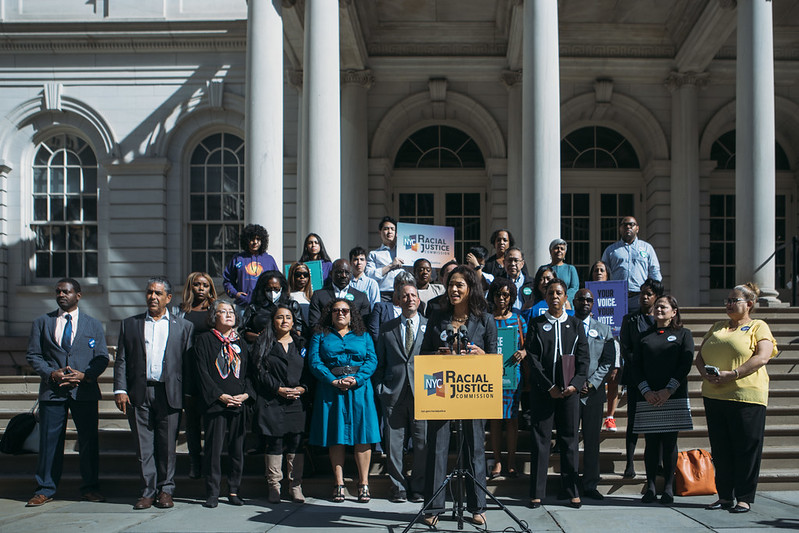
With the hope to make their concerns heard, Martinez and other parents gathered recently at City Hall to demand passage of that bill.
“This is the least the city can do for immigrants,” said Andrew Friedman of the Make the Road By Walking, a non-profit group that organized the rally. The group also organized a campaign for children and parents to write postcards to Mayor Michael Bloomberg, City Council Speaker Gifford Miller and education committee chair Eva Moscowitz to urge support of the bill.
Like many other parents, Nabia Duque believed the legislation would help her to be more involved with her kids.
“When I go to the PTA meeting, I don’t understand what happened half of the time,” she said in Spanish through a translator. “I felt so left out and after a while I just got up and left.”
Some parents said some schools tried to help non-English speaking parents but they lack funding and resources to give proper translation services.
“They are using [bilingual] children as translators,” said Vladimir Epststein of the Metropolitan Russian Parents Association. “Most of the time they make a lot of mistakes.”
This year the Department of Education created a new translation and interpretation unit and promised to spend additional $7 million on the program. Citing this new initiative, the department has expressed opposition to the legislation arguing that it is unnecessary and costly.
Friedman argued that the department plan is temporary. “They only promise to spend that $7 million in one year. Intro 464 is much more specific and comprehensive.”
An estimated cost of implementing The Education Equity Act is reportedly $20 million. “If you can find $200 million to fund tax rebate, you can definitely fund the translation,” he said.
Over half of the city council members supported Intro 464 but some Republican councilmembers have asked the mayor to come out publicly against it. So far Mayor Bloomberg has not expressed his position on the bill.
“The act diminishes motivation for parents to learn English and in turn prolongs their time to fully immerse into American society,” said Republican councilmember James Oddo. “There are more than 180 languages spoken in the public schools so the selection of eight to translate is not fair to other groups”
Some parents said that they have been studying English. “I am taking classes,” said a Brooklyn mother Irania Sanchez, “ But I don’t want to wait until my English is perfect to be involved in my daughter’s education.”
An immigrant from Bangkok, Thailand, Chaleampon Ritthichai is the editor of The Citizen.Â