Jian Quo Shen left his native Shanghai, China, five years ago to come to work in America so his aging parents can have a better life in their final years. Often working as $75-a-day laborer, he slept on a bunk bed in a tiny room in Chinatown.
But on July 7, 2004 in a construction site in Elmhurst, Queens a concrete wall collapsed and crushed him. He was the 14th day laborer killed since 1999. This accident came just two weeks after the death of Angel Segovia, a native of Ecuador, who fell from a third-story balcony roof in Brooklyn.
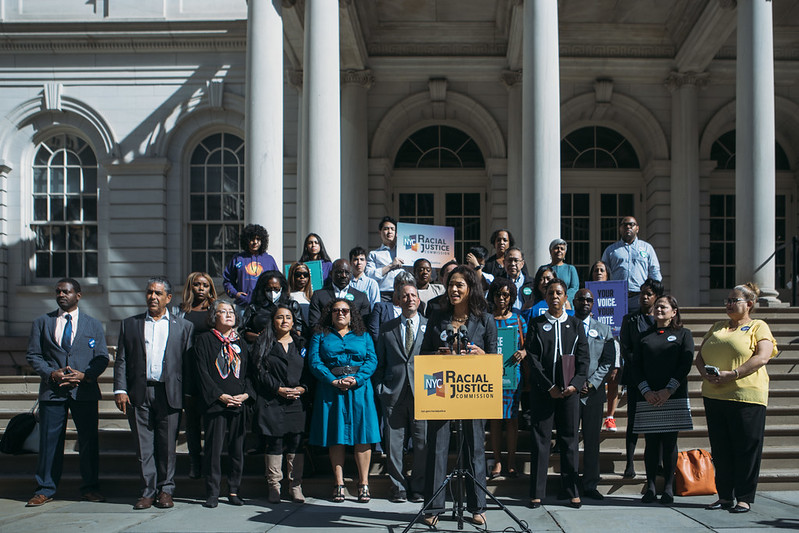
In an effort to prevent more such tragedies, the City Council passed a bill to establish a commission to look into how more job centers could be developed across the city to serve its estimated 8,000 day laborers who struggle to find employment each day are often subjected to low pay, long hours, and hazardous working conditions.
The bill, Intro 592-A, was passed by a vote of 43 to 2. According to the bill, A recent survey of day laborers in New York City found that almost 85 percent of those surveyed have experienced some type of abuse in the industry: 50 percent experienced non-payment of wages, and 56 percent were paid less than the agreed upon wage.
The temporary commission will consist of 20 members, appointed by the Council Speaker and the Mayor. At least 12 of them will be immigrant day laborers or representatives of groups with experience working on issues affecting immigrant day laborers. Officials from the Mayor’s Office of Immigrant Affairs, the Department of Small Business Services, and the Police Department will also be on the commission.
Councilmember Vincent Gentile from Bay Ridge, who helped draft the bill, said it was a "win-win" situation.
"Laborers are protected," said Gentile. "And for the community, laborers are not congregating on street corners."
Councilmember Helen Sears from Jackson Heights, who also contributed to the bill, admitted that undocumented immigrants pose another difficult issue.
"While there are many day laborers who are undocumented, there are many who are not," said Sears. "And those undocumented immigrants have been mistreated and abused. This bill will be able to prevent that."
But Councilmember Peter Vallone, Jr. from Astoria objected to language in the legislation that would grant 12 of the 20 seats on the commission to immigrant day laborers or representatives of groups working with laborers.
"This is giving the official sanction... to illegal aliens," said Vallone, Jr. "We are a body that makes the law. We should not be sanctioning breaking the law."
Similar issues have generated heated discussion in cities and suburbs across the country. While some cities like Los Angeles and San Francisco, welcome immigrant workers, others do not. Residents in Danbury, Connecticut, and Farmingdale, Long Island, have long complained about day laborers on their street corners, saying that they have threatened the quality of life in their neighborhoods.
According to the bill, job centers are organized to connect day laborers with employers seeking work in settings that provide accountability and help prevent workplace exploitation. But different from the employment agencies, which are prevalent in many immigrant communities, those job centers do not charge day laborers for their services and are administered by the local government or community-based groups. Most job centers require employers to sign a contract attesting to the wages agreed upon by the employer and the day laborer.
In addition, those job centers will provide a secure space for day laborers to congregate and offer bathrooms and shelter from bad weather conditions. Some sites will also help to connect day laborers to additional services, including classes on vocational skills, labor and immigration laws, and literacy skills in both Spanish and English. Community organizations may also offer social services on sites, including health care services, legal services, food pantries and peer support groups.
A native of Taipei, Taiwan, Larry Tung is a frequent contributor to the Citizen. Â