When New Yorkers go to the polls on November 8, it is not an exaggeration to say that their decisions will make history - and shape the city for decades to come.
If Mayor Michael Bloomberg is reelected, New York City will have a Republican mayor for 16 years, an unprecedented streak in an overwhelmingly Democratic city. If Democrat Fernando Ferrer is elected, he will become the city's first Latino mayor. Both candidates have also made promises for the future: to build tens of thousands of new homes, expand health care programs, and create new jobs for the next generation.
But there is more at stake than just the mayor's race.
Voters will also weigh in on half a dozen other seats - from public advocate to judgeships - and vote "Yes" or "No" on four ballot questions, including one that calls for $2.9 billion in repairs to roads, bus and train improvements, and major investment in the long-awaited Second Avenue subway.
To help voters before they go into the polling booth, we offer the following guide. And on the night of the election and in the days after, see Gotham Gazette's <http://www.gothamgazette.com/campaign2005_ge_results.php> Election Results.
I. THE MAYOR'S RACE
Who Is Running?
What Are the Candidates Saying?
II. THE OTHER RACES
Who Is Running for:
-Public Advocate?
-Comptroller?
-Borough President?
-City Council?
-Judicial seats?
-Clarence Norman's seat?
III. THE FOUR BALLOT QUESTIONS
What Are the Questions?
What Are the Arguments For and Against Each?
IV. THINGS TO KNOWN BEFORE GOING TO THE POLLS
Where Do I Vote?
What Do First Time Voters Need To Know?
What Are My Rights?
V. THE RESULTS
-How Do I Find Out Who Won?
• • • • • • • • • • • • • • • • • •
I. THE RACE FOR MAYOR
Who Is Running?
The two front-runners in the mayoral election are Republican <http://www.mikebloomberg.com/> Michael Bloomberg and Democrat <http://www.ferrer2005.com/main.cfm> Fernando Ferrer, but there are other mayoral candidates as well.<http://www.ognibeneforny.com/> Conservative Thomas Ognibene, <http://www.themilitant.com/> Socialist Worker candidate Martin Koppel, <http://www.audreysilkfornycmayor.com/> Libertarian Audrey Silk, <http://www.educationparty.org/> Education Party candidate Seth Blum, <http://www.greenmayor.org/> Green Party candidate Anthony Gronowicz, and Jimmy McMilan, who is running on the Rent is Too Damn High line, are all trying to earn New Yorkers' votes on Election Day.
For more on all of these candidates for mayor, <http://www.gothamgazette.com/campaign2005/52> click here.
What are the Candidates for Mayor Saying?
Even the most attentive voters have probably found it difficult to compare the mayoral candidates this year.
Mayor Michael Bloomberg has relied heavily on television ads and decided to attend only two debates, both in the week leading up to the election.
Fernando Ferrer argues that he will do more for the poor and working class New Yorkers, but several of his most prominent campaign platforms - such as building more housing, providing health care for children, and improving subway security - are things that Bloomberg vows to do as well.
But there are <http://www.gothamgazette.com/blogs/wonkster/2005/10/25/155/> distinct differences between the candidates, and each has specific plans for education, taxes, development, crime, and healthcare.
For how Bloomberg and Ferrer differ, read <http://www.gothamgazette.com/article/issueoftheweek/20051017/200/1621> The Real Issues in the Mayor's Race.
Compare the candidates' stances on education, housing, taxes, health care, and transportation with Gotham Gazette's <http://www.gothamgazette.com/mayor_grid_05_1.shtml> Mayoral Issue Grid.
Read a transcript of the debate held on October 30. Also read the transcript of the final debate held on November 1.
And visit Gotham Gazette's blog Wonkster for a roundup of opinion on the election.
II. THE OTHER RACES
Who Is Running in the Other Races?
Public Advocate
The public advocate is the second-highest official in the city, a "watchdog" over the mayor and the rest of city government. This year, incumbent Public Advocate Betsy Gotbaum is facing three challengers: Republican Jay Golub, Libertarian Jim Lesczynski, and "subway-gunman" Bernard Geotz, who is running on the Rebuild party line. (<http://www.gothamgazette.com/campaign2005/53>Click here<http://www.gothamgazette.com/campaign2005/53> to learn more about the race.)
Comptroller
The comptroller keeps track of the city's fiscal policies and financial transactions. This year, incumbent Comptroller Bill Thompson faces three challengers: Socialist Worker candidate Daniel Fein, Libertarian Ron Moore, and Conservative Herbert Ryan. (<http://www.gothamgazette.com/campaign2005/54>Click here for more on the race.)
Borough President
Each of the city's borough presidents is also up for reelection this year. In September, Democrat Scott Stringer won a crowded primary for Manhattan Borough President. Now, he faces four other candidates in the General Election. <http://www.gothamgazette.com/campaign2005/57> Click here for more on the Manhattan Borough President race. Also see races for <http://www.gothamgazette.com/campaign2005/55> Bronx<http://www.gothamgazette.com/campaign2005/55> , <http://www.gothamgazette.com/campaign2005/56> Brooklyn<http://www.gothamgazette.com/campaign2005/56>, <http://www.gothamgazette.com/campaign2005/58> Queens<http://www.gothamgazette.com/campaign2005/58>, and <http://www.gothamgazette.com/campaign2005/59> Staten Island<http://www.gothamgazette.com/campaign2005/59> Borough President.
City Council
There will be at least nine new members of the City Council elected this year because of term limits, and the remaining 42 incumbent City Council members all must run for reelection (though a dozen are unopposed).
The most competitive races in the General Election are for four seats in which Republicans and Democrats each have strong candidates. (Read the article <http://www.gothamgazette.com/article/issueoftheweek/20051021/200/1631> City Council Races to Watch.)
In <http://www.gothamgazette.com/campaign2005/4> district 4 on the Upper East Side, Democrat Dan Garodnick, Libertarian Jak Jacob Karako and Republican Patrick Murphy are fighting for the seat left vacant after the current City Councilmember Eva Moskowitz decided to run for Manhattan Borough President. (Read a transcript of a <http://www.gothamgazette.com/article/issueoftheweek/20051024/200/1629> district 4 debate.)
In <http://www.gothamgazette.com/campaign2005/5> district 5, also on the Upper East Side, Democrat Jessica Lappin and Republican Joel Zinberg are facing off for the seat of City Council Speaker Gifford Miller, who must leave office because of term limits. (Read a transcript of a <http://www.gothamgazette.com/article/issueoftheweek/20051024/200/1629> district 5 debate.)
In <http://www.gothamgazette.com/campaign2005/13> district 13 in the Northeast Bronx, Republican Philip Foglia and Democrat James Vacca are campaigning for an open seat.
In <http://www.gothamgazette.com/campaign2005/43> district 43 in Brooklyn, City Councilmember Vincent Gentile faces such a tough challenge from Republican Pat Russo, who he narrowly defeated in 2003.
To find who is running in your City Council district:
1. Go to Gotham Gazette's Campaign 2005 <http://www.gothamgazette.com/campaign2005> section
2. Go to "Find Your District" on the right hand side of the page.
3. Type in your address and zip code.
4. Click "Go."
On the district page, you will find a list of candidates running, information about their campaign contributions, candidate biographies, and an archive of news stories from the campaign trail.
You can also click on the link to the <http://www.nyccfb.info/debates_vg/voter_guides/general_2005/index.aspx> Campaign Finance Board's Voter Guide located on each district page for more information about the people running in your neighborhood.
District Attorney
While there are technically races for District Attorney in Manhattan and Brooklyn, the winners were decided in the Democratic Primary in September. Incumbent <http://www.gothamgazette.com/campaign2005/62> Manhattan DA Robert Morgenthau and <http://www.gothamgazette.com/campaign2005/63> Brooklyn DA Charles Hynes are running unopposed in the General Election.
Judicial Seats
New Yorkers will also elect State Supreme Court Justices, and judges to the Civil Court. In <http://www.gothamgazette.com/campaign2005/65> Manhattan and <http://www.gothamgazette.com/campaign2005/64> Brooklyn, voters will elect the Surrogate's Court judge.
Because judicial candidates are not allowed to take public positions on issues that they may rule on, it is difficult for voters to choose between candidates. The State Supreme Court has a<http://www.nycourts.gov/vote/> voter guide that provides some background information. The New York City Bar also rates judicial candidates.
Brooklyn State Assembly Seat - District 43
Residents of Crown Heights, Brooklyn will vote in a special election to choose a replacement for State Assemblymember Clarence Norman, who was found guilty in September of mishandling campaign contributions.
Three candidates are running to fill the space: Democrat Karim Camara, Republican Kenneth Cook, and Independence candidate Geoffrey Davis, the brother of former Councilmember James Davis who was shot in City Hall in 2004. (Read an article about the race.)
III. THE BALLOT QUESTIONS
(Read The Fine Print on the Ballot for everything you need to know about the four questions on the ballot.)
When New Yorkers go to the polls on November 8, they will also be asked to vote "Yes" or "No" on four ballot questions - two statewide initiatives and two specifically for New York City. The wording of these questions on the ballot is long and confusing. It is best to research each of them ahead of time.
Question 1: Amending the State Budget Process <http://www.empirepage.com/ballots.html>
This measure changes how the state budget is enacted into law.
Currently, the governor develops a budget and submits it to the State Legislature, which has limited ability to amend it. Under this proposal, the State Legislature would have greater power to shape the budget than it does now. This measure states that if the governor and legislature do not agree on a budget by the beginning of the fiscal year, a contingency budget - based on the previous year's budget - would provide the basis of the new budget.
Other provisions of the ballot measure would establish an Independent Budget Office whose members are appointed by the legislature and move certain items onto the general budget that are currently funded independently. (Read the <http://www.nyccfb.info/debates_vg/voter_guides/general_2005/ballot_nys01.as px#see> text of the question as it will appear on the ballot.)
Pro:
Proponents <http://www.commoncause.org/atf/cf/%7BFB3C17E2-CDD1-4DF6-92BE-%20BD442989366 5%7D/BUDGET%20REFORM%20FINAL%20REPORT.PDF> say the amendment will bring accountability and transparency to the state's budget process. It will encourage on-time budgets, while shifting some power from the governor to the legislature would bring New York into line with most other states.
Read "Vote Yes on Proposition 1" by Megan Quattlebaum and Blair Horner.
Con:
Opponents <http://www.manhattan-institute.org/rm/ECNY-09-20-05.ram> argue that this would almost guarantee late budgets because the legislature would only have power when no agreement with the governor can be reached.
Read "Vote No on Proposition 1" by Gerald Benjamin and Charles Brecher.
Question 2: Transportation Bond Act <http://www.dot.state.ny.us/>
This measure calls for New York State to borrow $2.9 billion for various transportation projects. Half of the money would go to the Metropolitan Transportation Authority to help fund the construction of such projects as the Second Avenue subway and the extension of the Long Island Rail Road to Grand Central Station and for new buses and cars for subway and commuter rail lines. The rest would go toward road and bridge projects around the state, including some in the city. Voters rejected a similar measure in 2000. (Read the <http://www.nyccfb.info/debates_vg/voter_guides/general_2005/ballot_nys02.as px#see> text of the question as it will appear on the ballot.)
Read an article about the Transportation Bond Act.<http://www.gothamgazette.com/article/transportation/20051017/16/1620>
Pro:
Proponents say that the state's transportation infrastructure is in poor condition and this borrowing is a necessary investment in the future. It would help pay for much needed projects.
Read <http://www.gothamgazette.com/article/fea/20051017/202/1618> "Vote Yes on the Transportation Bond Act" by Jeremy Soffin.
Con:
Opponents argue that the state is already burdened with too much debt, and borrowing such a large amount of money will lead to more fiscal problems and higher taxes.
Read <http://www.gothamgazette.com/article/fea/20051017/202/1619> "Vote No on the Transportation Bond Act" by Nicole Gelinas.
Question 3: Establishing an Ethics Code for Hearing Officers <http://www.nyc.gov/html/charter/downloads/pdf/crc_ballot_questions.pdf>
This measure would amend the City Charter by allowing the mayor to establish a code of ethics for administrative hearing officers, who resolve citizen complaints and adjudicate a range of non-criminal matters, such as parking tickets, noise complaints and building code violations. (Read the <http://www.nyccfb.info/debates_vg/voter_guides/general_2005/ballot_nyc03.as px> text of the measure as it will appear on the ballot.)
Read an overview of Proposition 3.
Pro:
Proponents argue that this measure will encourage uniform conduct among administrative judges, improving the fairness, uniformity, and efficiency of hearings.
Read "Vote Yes on Proposition 3" by Peter J. Kiernan.
Con:
Opponents argue that an ethics code could be passed by the City Council or instituted by the mayor through an executive order, and that this is just an effort to block other measures from the ballot. They also say it gives no specifics about either the content of the code or the process by which the mayor will develop this ethics code.
Read "Vote No to Proposition 3" by Richard N. Gottfried.
Question 4: Adding Financial Management Requirements to the City Charter
In response the 1975 financial crisis when New York City nearly went bankrupt, the state imposed a series of financial management practices and created the Financial Control Board, comprised of members from both the state and city, to oversee the city's finances. Some of these oversight measures will expire on July 1, 2008.
This proposed amendment seeks to preserve many of the current financial control provisions in city law, including requiring a balanced budget, maintaining a four-year financial plan, limiting the amount of short-term debt, and performing an annual audit. (Read the <http://www.nyccfb.info/debates_vg/voter_guides/general_2005/ballot_nyc04.as px#see> text of the question as it will appear on the ballot.)
Read "The Fiscal Crisis After 30 Years" <http://www.gothamgazette.com/article/issueoftheweek/20051010/200/1612> by Joshua Brustein.
Pro:
Proponents of the measure say that the charter revisions would guarantee that the city continue to act responsibly after the Financial Control Board's expiration. (Read arguments for Proposition 4 <http://www.nyccfb.info/debates_vg/voter_guides/general_2005/ballot_nyc04.as px#pro>)
Con:
Critics argue that this is not a comprehensive solution. Without a specific, independent entity to assess whether the city is fulfilling its responsibilities, they argue, there is no way to keep city officials honest.
IV. THINGS TO KNOW WHEN YOU GO TO THE POLLS
Where Do I Vote?
Registered voters should receive a postcard in the mail with the address of their polling place. If you did not, try the Board of Elections' <http://gis.nyc.gov/vote/ps/index.htm> online <http://gis.nyc.gov/vote/ps/index.htm> poll site locator. You can also try calling the Board of Elections at 1-866-VOTE NYC.
Polls open at 6:00 a.m. and close at 9:00 p.m.
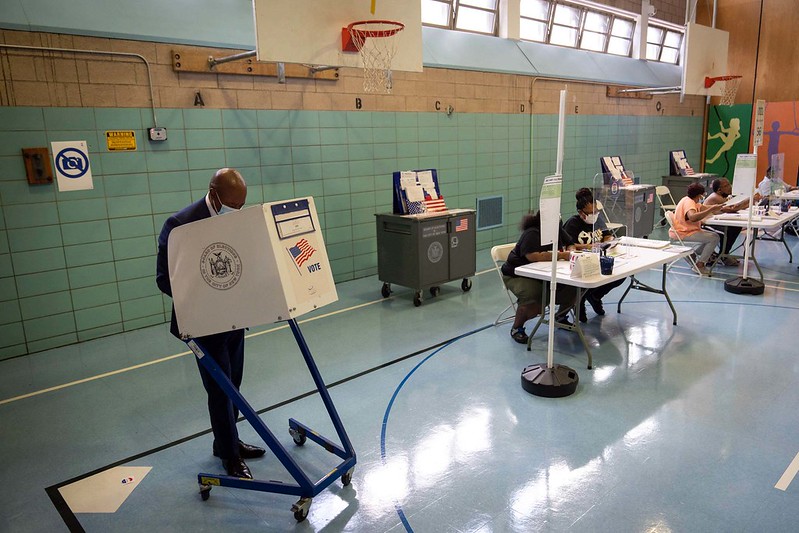
On their website, the Board of Elections also has instructions <http://vote.nyc.ny.us/voting.html#machine> for how to work the voting machine.
Absentee ballot applications can be obtained calling the Board of Elections at 1-866-VOTE-NYC, e-mailing a request to This email address is being protected from spambots. You need JavaScript enabled to view it. .
Those who wish to vote by absentee ballot have two choices:
Deliver by mail: To be counted, an absentee ballot must be postmarked by the day before Election Day and must reach the Board of Elections no more than seven days after the election.
Deliver in person: You can drop off an absentee ballot at one of the Board of Elections borough offices by 9:00 p.m. on Election Day.
What Do First Time Voters Need To Know?
New voting regulations may cause confusion at the polls.
New Yorkers who registered to vote for the first time via mail after January 1, 2003, may be asked to provide identification, such as a driver's license, when they go to the polls.
Those without a driver's license can also offer a copy of one of the following: a valid photo ID, a current utility bill, a bank statement, a government check or other government document that shows the voter's name and address.
Those who don't have any form of identification or refuse to supply one will be allowed to vote on paper ballot, not in the machines, according to the Board of Elections. Those votes will be counted if they are verified to match registration forms.
The new rule is part of the federal Help America Vote Act, which Congress passed after the turmoil in Florida during the 2000 presidential election.
What Are Your Voting Rights?
The New York Voter's Bill of Rights guarantees the right to:
Vote: The right to vote includes voting for candidates and questions on the ballot.
Have Your Vote Count: Vote on a voting system that is in working condition and that will allow votes to be accurately counted.
Secrecy in Voting: Secrecy in voting will be preserved for all elections.
Freedom in Voting: Cast your vote, free from coercion or intimidation by poll workers or any other person.
Permanent Registration: Once registered to vote, you will continue to remain qualified to vote from an address within your county or city.
Accessible Elections: Non-discriminatory equal access to the election system for all voters, including the elderly, disabled, alternative language minorities, military and overseas citizens, as required by federal and state laws.
Assistance in Voting: You may ask for help in voting because of blindness, disability, or inability to read or write.
Instructions in Voting: You can view a sample ballot in this polling place prior to voting, and before entering the machine, you may request help in how to operate the machine.
Absentee Voting: If you will be out of your county of residence on Election Day, or are unable to go to your polling place due to illness or physical disability, you may cast an absentee ballot.
Affidavit Voting: Whenever your name does not appear in the official poll book, you will be offered an affidavit ballot.
What If I Encounter Problems At The Polls?
If a poll worker says you are not on the list, ask an inspector to verify that you are at the correct Election and Assembly District for your address. If you believe that you are eligible to vote, you can ask for a paper or affidavit ballot. After the election, the Board of Elections will check its records and your vote will be counted if you are deemed eligible to vote and were at the correct polling site.
The Board of Elections says that it has increased efforts to make polling places accessible for senior citizens and handicapped voters, but they admit that there are still problems at some sites. Voters who feel that their polling site is inaccessible should call the Voter Registration Unit of their local borough office for information.
If you encounter problems at the polls, call one of the following places:
- League of Women Voters Election Day Hotline: 212-725-3541
- New York Public Interest Research Group: 212-822-0282
- New York Civil Liberties Union: 212-344-3005.
For assistance in Chinese, Korean, Tagalog, Hindi, Khmer and English, call the Asian American Legal Defense Fund <http://www.aaldef.org/> at 800-966-5946.
V. THE RESULTS
How Do I Find Out Who Won?
On the night of the Election beginning at 9:00 p.m. when the polls close, and in the days after, visit <http://www.gothamgazette.com/campaign2005_ge_results.php> Gotham Gazette's Election Results<http://www.gothamgazette.com/campaign2005_pe_results.php>.
Â