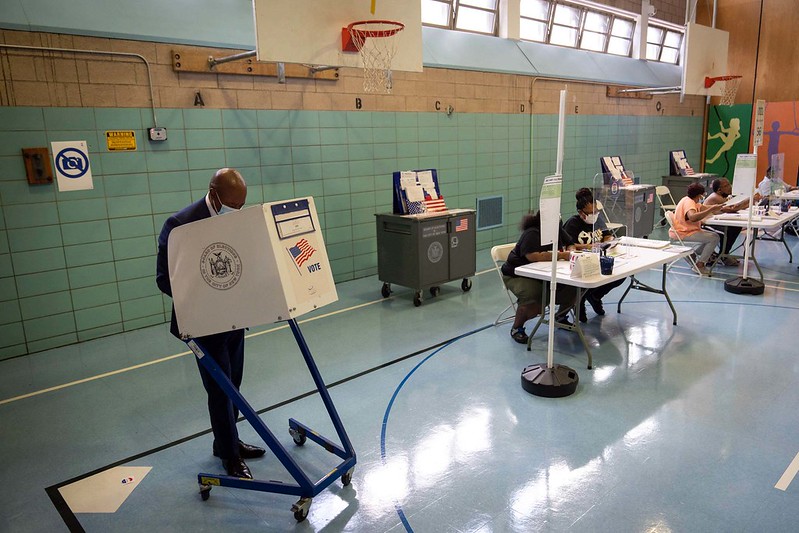
This fall will be a historic election, not because New Yorkers will be deciding who the next mayor will be — we do that every four years — but because we will be doing it for the last time on the familiar voting machines that have shown up in our churches, schools and community centers every fall for more than four decades.
Yes, the Shoup 3.2 lever machines, those awkward metallic boxes long in need of replacement, will be gone after November, if all goes the way it is supposed to.
What will replace them?
The New York State Legislature was supposed to decide that, following guidelines from the federal Help America Vote Act, or HAVA , passed by Congress in 2002 in response to the chaos of the 2000 Presidential election. But, after failing for years to agree on a uniform statewide voting machine, state legislators are deciding not to decide. Instead, they will leave it up to each of the state’s 62 counties.
For better or for worse, decision-making on New York City’s next voting machines will now rest with the New York City Board of Elections.
Choice Of New Machines
There are two main contenders to replace the antiquated lever machines used currently. There are optical scan machines, much like the fill-in-the-bubble “scantron” system used to administer standardized exams. Then there are direct recording electronic machines (DREs) more closely resembling ATM cash machines.
While the replacement of our lever machines was never in doubt, the challenge for the state legislators has been deciding which of these types of machines we should choose; how stringent the standards should be; and who would make the decision on machine purchase.
Since HAVA set only bare minimum standards for new machines, state legislatures are empowered to set additional standards — such as a voter verifiable paper trail to ensure machine counts are accurate in the case of discrepancies — and even select a statewide machine should they choose to do so. However, these decisions can also be left to the counties.
No Agreement By State Legislators
Forging an agreement on machines in the New York State Legislature has proven to be nearly impossible. For two years now the legislature has made only piecemeal progress towards any decision, its delay pushing New York State to the brink of non-compliance with HAVA and the loss of over $153 million in federal funds for New York. As the State Assembly pushed hard for inclusive and uniform statewide standards to ensure greater and equal access for all voters across the state, the State Senate held firm on stricter language to ensure security and prevent against potential voter fraud. The clash of these positions has prevented a compromise.
It now appears that the Democrats in the Assembly are ready to concede their position on a mandated statewide machine, and the counties will be in charge of their voting machine purchases. In light of the inability of our State Legislature to work across party lines and between houses, it is no great surprise that they cannot come to a conciliatory agreement. But as New York has dragged its feet on this key provision of HAVA, as well as the bulk of HAVA’s other requirements, we are currently one of the last states to remain in non-compliance with the federal legislation. And with the quickly approaching January 1st deadline the state has positioned itself to face numerous challenges above and beyond the replacement of the old machines.
County Officials: Winners or Losers?
With the State Legislature in Albany deciding not to decide, county officials across the state are now faced with a rushed timeline, as well as sudden pressure from lobbyists for machine vendors and various advocates, who up until now were focusing their efforts in the state capital. Many civic groups are concerned that with the fragmented procurement process, and the millions of dollars in contracts that are at stake, transparency and accountability will be compromised as regulations governing lobbying on a local level are more opaque than at the state level.
Whatever new machine is picked, the counties will have to launch massive voter education efforts with new and old poll workers having to be trained or retrained en masse. Technicians will have have their hands full ensuring that the post-Shoup era is launched successfully. Troubleshooting will need to be done on the fly.
New York City, with close to four million voters, may face the most daunting task of all ahead. While there are five counties in New York City, the New York City Board of Elections acts as a unifying body for the purposes of election administration. According to its executive director, John Ravitz, the Board of Elections had hoped to phase in the new machines over a three election cycle. “That option was taken away from us by the State Legislature,” Mr. Ravitz said at a recent hearing at City Hall.
Under the leadership of Ravitz, the board has not been passively waiting for a decision from Albany; they have been reviewing the different voting systems available since HAVA was passed in 2002. As of yet, they have not reached a decision on what machine best suits the needs of New York City voters.
However, the New York City Board of Elections is viewed generally to be in a better position to negotiate a contract in the absence of a statewide decision because about half of registered voters in the state reside in New York City. With our needs pegged at about 5,000 to 10,000 new machines and each machine costing somewhere between $6,000 to $11,000 (the lower range of both for optical scan and the higher range for DRE) the costs and contracts could be as much as $100 million.
New York City also has unique language and access needs that may have made the negotiating process at the state level more difficult than it would have been otherwise. The ability of New York City to choose a voting system independently of the state, and not settle for a compromise machine that may have come through a statewide uniform system, may just provide the city with flexibility necessary to focus on its unique and important needs. In any case, the clock is ticking.
Doug Israel is the director of public policy and advocacy for Citizens Union Foundation, which publishes Gotham Gazette.