After many years of effort a greenway of parks and paths rings most of Manhattan now – with some notable exceptions. One such exception is the Lower East Side.
The Lower East Side used to have spectacular access to the East River, thanks to the East River Park, built by master planner Robert Moses in 1939, and including a walkway built on bulkheads over the river, offering breathtaking views. But repairs and improvements were sporadic and piecemeal, and, in the summer of 2001, divers inspecting it found structural weakness in the retaining wall. Before the July 4 hordes could descend on the river to view fireworks, the city blocked off almost all of the walkway.
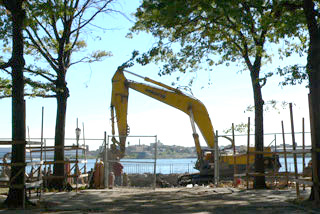
Three years after the city deemed the path as unsafe, a sturdy eight-foot chain link fence blocking access to the waterfront looked like a permanent fixture. Because of post-9/11 budget constraints and a lack of community advocacy or business interest, it seemed unlikely that fixing the esplanade along the river would happen soon, if ever.
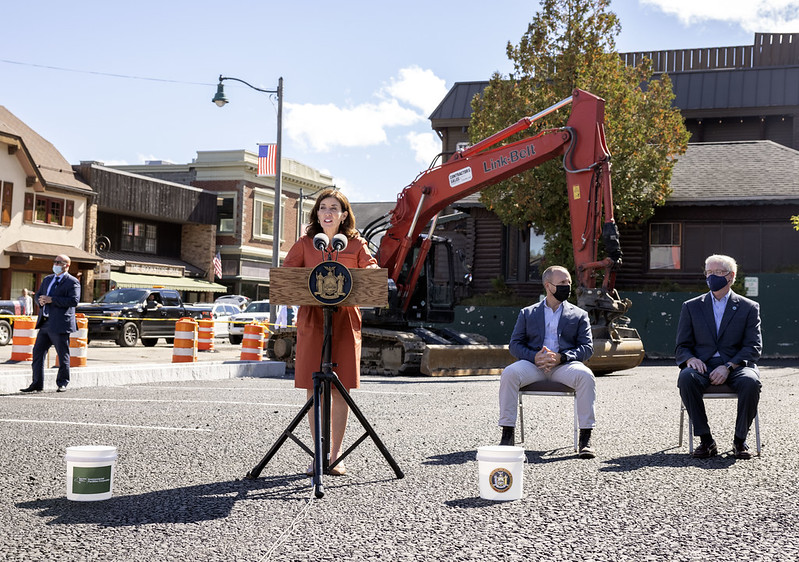
But, in a surprising turn, this long-neglected section of Manhattan’s greenway is slated to come back to life. It will take two more years and a whopping $69 million, but the heavy equipment is already there, working away.
No great public outcry had greeted the closing of river access. This was not the West Side with high-priced residential and business interests and vocal, connected constituents. On the East Side below 14th Street, the Jacob Riis, Lillian Wald and Baruch public housing projects are adjacent to the park across the FDR. It is interesting to note that most of the gaps in the Manhattan greenway are similarly adjacent to low-income neighborhoods.
Rosie Mendez, who has won the Democratic primary for the City Council district that includes East River Park, worked for the district's Councilmember Margarita Lopez (who is leaving that office because of term limits). Mendez says that former Mayor Rudy Giuliani refused to put money in the budget for infrastructure. When the promenade closed, "the mayor said she [Lopez] should get capital money to do the repairs," says Mendez, even though "infrastructure is what the city has to do, and it was a lot of money." That wasn't the kind of money that Lopez could get. Council members' discretionary funds get stretch thinly among schools, libraries, parks, and nonprofits.
Until recently, the community had other things on its mind, according to Richard Ropiak of Community Board 3. "Several other things the board focused on have been addressed," he says, "Drugs, housing, public safety. Once you solve major, visible things, you can focus on other things, such as parks." And that's the board's "prime focus" now, he says.
The community board has the power of advocacy, not the power of the purse. Now, with the mayor making parks and a greenway around Manhattan a priority, the park has funding as well. Rosie Mendez credits Bloomberg for allocating the money for the work to be done on the promenade. Plans are underway to complete the greenway all around Manhattan.
The infusion of funds for the promenade below 14th St. came two years ago in the mayor's fiscal year '05-'06 budget, says Nancy Barthold, assistant commissioner for capital projects in the parks department. No state or federal money has gone into the project, and it's a big one for the city. "Our typical project is a playground for between $500,000 and $1 million," says Barthold. Planning began in 2004 and the actual work started at the beginning of this year.
Still, it's going to be 2007 before anyone sees much river up close. It's a process with complicated and expensive steps, says Barthold. Before new pilings could be built, Con Ed had to move an old oil line and move live underground wires. The company bears the cost of such work, says Con Ed spokesperson Joe Petta.
As they finish 500-foot sections, the contractors building the pilings can move in and rip up the old structure, says Barthold. The barges and heavy equipment just south of 14th St. have made a torn-up landscape, but that's construction. Some $54 million is going to the bulkhead construction. The actual building of the promenade with benches, plantings, and lights will cost $13 to $15 million. That part of the project is currently being sent out for bids. Barthold says it should be done in the summer of 2007, though the Parks Department website says 2008.
That's not the only improvement East River Park has seen. In the past two years, the park has gained refurbished ball fields (funded through the Lower Manhattan Development Corporation, which was created to rebuild lower Manhattan after 9/11), playgrounds and a rebuilt outdoor amphitheater (which had been the first home of Shakespeare in the Park). There are working public toilets and plans for more.
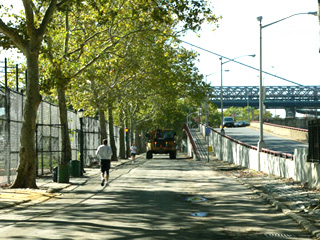
But much of the park—the largest in lower Manhattan--lives in a state of dishabille. A grassy patch turns brown. Another, greener lawn rarely gets a mowing. A broken water fountain falling into a sinkhole has had a tidy little chain link fence around it for years. Bikers and walkers now traverse a noisy path up against the FDR that is always either dusty or flooded. That's the way it will remain until the promenade reopens.
The shabbiness doesn't stop the streams of people. Runners, dog walkers, parents with strollers, skateboarders, bicyclists, and family gatherings pulse through the paths and picnic areas. Chain link, noisy construction and disrepair don't stop people from crossing over the FDR Drive. The neighborhood doesn't wait for the park that will be. It uses the park that it has.
Â