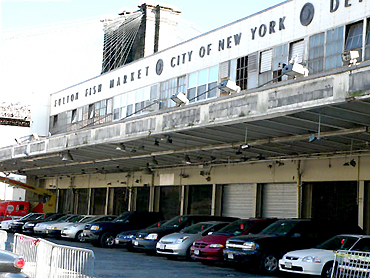
Until last fall, whenever I bicycled through the Fulton Fish Market in the early mornings, the street was filled with hundreds of burly workers, beeping forklifts, and crate after crate of seafood, enough seafood to supply the entire city. There was a slimy layer of water and grime over the whole street. I'd go slow to keep fish slime from spraying my pants and to avoid slipping in potholes or skidding on bits of palettes and boxes and other debris that filled the street.
Then, in November, after 180 years on Fulton Street, the "Fulton fish market" moved to Hunts Point in the Bronx. (See the slide show, Remaking Hunts Point) Now, Fulton Street has become clean and peaceful, though still potholed.
It is also largely desolate, especially on weekdays. Losing the fish market and 600 jobs that went with it meant losing the only large, thriving enterprise in the neighborhood. I am surely not the only one to miss the fish slime.
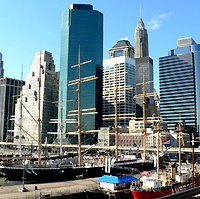
Yes, a certain majesty remains, thanks to the South Street Seaport Museum's half-dozen historic ships docked at Pier 16. But right now, only one area in the neighborhood looks stable -– the cobblestoned pedestrian streets at the foot of Fulton Street, which make up the core of the landmarked district, and house both the galleries of the South Street Seaport Museum (in its recently renovated building on Schermerhorn Row) and such shops as The Gap, J. Crew, and The Body Shop. But even here business is slow: It may well be a sign of desperation that even long-time workers in the area are happy to see the popularity of "The Bodies," a gruesome exhibition of cadavers displaying muscles and internal organs that have been replaced with polymer, because, freak show that it is, it nevertheless draws people into the Fulton Market Building.
Worse is Pier 17, the South Street Seaport shopping and dining complex, which was built in 1983 to energize the neighborhood, but never lived up to expectations. After the World Trade Center fell less than a mile away, it became comatose. Most of the businesses are surviving on month-to-month leases; there are empty storefronts.
All this is about to change. The entire neighborhood –- including but not limited to the area where the shabby fish stalls stood -– will soon be transformed. What it will become, though, is just starting to unfold.
A Center For Art?
The Drawing Center, an exhibition space currently in Soho, hopes to take over the site of one fish market building.
The Drawing Center jumped at the possibility of the Fulton Fish Market site after they had to abandon plans to move to the World Trade Center complex.
They've looked at tearing down the building as part of the redevelopment of the whole area, which will be "very upgraded," says George Negroponte, president of The Drawing Center, in an e-mail. The building is one of the few in the area not protected by landmark status, so they have plenty of choices. "It is far too early for us to envision what we might do on the site," says Negroponte. "For instance, one consideration we've discussed lately is preserving some or all of the existing building. But in all fairness, we are just playing with ideas."
He is optimistic. "The discussions have been very favorable so far because everyone supports The Drawing Center having the site," says Negroponte.
However, they have not yet talked with the developers about what's going on next door at Pier 17 or the other fish market buildings.
A Big Mall?
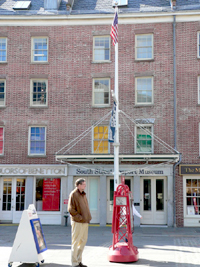 What happens there is up to General Growth, a company that runs more than 200 shopping malls around the country. The company holds options on the leases for two other city-owned fish market buildings that are part of the district that has been landmarked since 1977. At present it seems to be interested in high-end retail to fill the stalls on both sides of the street.
General Growth can tear down the sparsely visited three-story mall on Pier 17, which is not part of the landmarked district, and build something new. What it would be, they are not saying; they promise to unveil ideas in coming months. "We're looking at everything that would be of service to the neighborhood including retail, dining, entertainment, hotels," says Michael Piazzola, the company’s general manager for the project.
Whether General Growth is capable of a successful transformation is another question. Most of the malls listed in their holdings on their website are simply malls. Properties include the Staten Island Mall and the Paramus Park in New Jersey. When General Growth acquired Rouse in November 2004, they gained more high-end, mixed-use developments and tourist-centered malls including Faneuil Hall in Boston, Riverwalk in New Orleans—and South Street Seaport.
There is hope for graceful redevelopment. General Growth has commissioned plans from the architecture firm of Beyer Blinder Belle, the company that refurbished Grand Central Terminal so beautifully.
A New Hip And Ritzy Neighborhood?
While developers are snapping up the area, the renovation of the neighborhood, akin to what happened in the Meatpacking District, is not a slam dunk. The FDR Drive runs overhead along the river next to South Street. It casts a formidable shadow and creates a visual and psychic divide between the riverfront and the city.
Still, unlike residents in other areas of the city, it seems unlikely that the community would put up much resistance to expensive development, judging from the views of Victor Papa, who serves on Community Board 1 and is president of the Two Bridges Neighborhood Council: With the real estate rising so drastically, “only the fancy and sophisticated can come down here."
A builder, Sciame Development, already has created expensive new and renovated apartments along Front Street. Their best-known and most spectacular project will the building at 80 South Street, a residential tower of cantilevered cubes designed by Santiago Calatrava, who also designed the bird-on-the-wing transportation hub planned for the World Trade Center site. Apartments will start at $29 million.
Housing? Manufacturing? Memorial? Parks And Ships?
No one is speaking of other alternatives for the area, either affordable housing or manufacturing. A big-box store such as Home Depot or Target, which had been considered, seems to be off the table. "It'll never happen. It's not sophisticated enough," says Papa of the community board. What may happen – or what he would like to see happen -- is some kind of tribute to the thousands of immigrants and children of immigrants who kept the fish market running in all weather for nearly two centuries.
There is also hope for a more vibrant area because the city, with $150 million of post-9/11 Lower Manhattan Development Corporation money, plans to make the riverfront more accessible with new buildings, lighting and promenades under the FDR. Pier 15 next to the historic ships will be rebuilt. That could provide a park-like pier, as the city has built on the Hudson River side. Richard Stepler, who directs special exhibitions at the South Street Seaport Museum, hopes for a place to dock two schooners that there is no room for now. Carter Craft of the Metropolitan Waterfront Alliance dreams of water transportation that would bring people to and from Brooklyn, Governors Island and other parts of the city. Plans include making Peck Slip and Burling Slip into wide graceful esplanades. Projects should be complete in three to five years.
Turning A Question Mark Into An Exclamation Point
Carter Craft sees an opportunity. "There's a combination of old and new I find exciting. It's got great bones." Right now, though, he sees a diffuseness there, "sort of shopping, sort of historic, sort of things to see. You need to evoke â€Seaport exclamation point!’ Now it's kind of â€Seaport question mark?’”
Piazzola of General Growth sees three groups that together should make the area thrive:
- Residents of Lower Manhattan earn an average household income of $103,000.
- Tourists flock to the Battery, Wall Street, and the World Trade Center site and could be drawn to South Street.
- And there are 300,000 workers a day who commute to the area.
There are practical considerations, such as public transportation and parking. The nearest subway stop is Fulton St., several unattractive blocks away. Downtown Alliance runs a shuttle bus from South Street Seaport to Battery Park City . There are some 3,000 parking spaces in the area.
No clear timeline has yet been set for the commercial transformation of The Fulton Fish Market or South Street Seaport shopping center on Pier 17. For now, the fish stalls are closed. The trucks, forklifts and burly workers no longer fill the streets, and strong odors no longer permeate the air. What's in the air now is change.
Â