This is the first story in a series on the mayoral candidates.
A wall of city workers lines Broadway, rubbing up against the wrought iron gate surrounding City Hall Park. Parents strap cardboard placards around their neck, shouting in defiance at the latest round of budget cuts trickling out of the west side of City Hall.
Comptroller William Thompson Jr. appears near the park's southern edge ready to capitalize on a large crowd that's frustrated with Mayor Michael Bloomberg's fiscal priorities. Surprisingly to some in attendance, people take notice.
"Yay, Bill Thompson, Bill Thompson," shout a gaggle of women, hands waving toward the candidate. They catch his attention, and he trots over. Some reach out for a hug from the mayoral contender, others beam with wide smiles.
"Bill Thompson, the next mayor," said Patricia Thousand, a 54-year-old Brooklyn cook. Around her neck a blazing yellow sign reads, "Head Start is the Backbone of the Working Poor." Brought to the edge of City Hall by budget cuts, Thousand explains later that it's time for Bloomberg to go.
As for Thompson, "I'm supportive of him, because he's down to earth," said Thousand.
Thousand is not alone. It seems as though no one, including the mayor himself, has anything bad to say about the city's soft-spoken (shy by some descriptions) comptroller. Affable, approachable and a pragmatic mediator, "Billy" Thompson has few critics -- at least that I could find -- and even fewer enemies.
He is non-threatening, which may be exactly the problem. A matchup that rivals David and Goliath, this year's mayoral contest is a fait accompli to many. Only divine intervention, insiders quip, could change the odds. Thompson limps behind Bloomberg in the polls, has little name recognition and, some allege, has failed in the first months of his campaign to increase his visibility.
But ironically, insiders, colleagues and friends say, if Thompson stands any chance, all eyes should not be focused on this lifelong politico. Instead, they should be focused on Bloomberg.
A Boy From Brooklyn
For most of his political career, Bill Thompson has been able to enter a room without attracting much attention. Now, people perk up more -- ever so slightly.
At least for the time being, he is the only viable candidate willing to make a run at the seemingly invulnerable billionaire Bloomberg, who is expected to spend $100 million on his race for a third term. Why is Thompson the one to take him on? In addition to thinking he's the right man for the job, Thompson said he had a mayoral race written into his schedule.
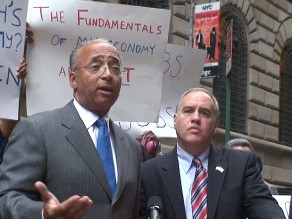
In fact, he has been thinking about it at least since 2003, during his first term as comptroller. Now, after seeing the voter turnout for President Barack Obama last year, he won't be dissuaded.
Sitting in a high-backed leather armchair in his office on the fifth floor of the municipal building, Thompson, dapper as usual with a perfectly matched tie and shirt, peers over his sans-rimmed glasses and explains.
"Campaigns are about a person," Thompson said. "Do I think I identify better with the average New Yorker?" He paused, then answered with a definite, "Yes."
Eventually, he added, "New Yorkers (will) take note of the fact that the mayor's not there for them."
Thompson argues, given his background, that he will be.
Billy Thompson, a Jack Bauer and 24 enthusiast who will turn 56 in July, is a member of the city's second-generation, nouveau political elite. A career in politics that started at the age of 25 working for the former Rep. Frederick W. Richmond, before the congressman pled guilty to tax evasion, Thompson has been nurtured by Brooklyn's political machine for decades.
His father was an Appellate Court judge, state senator and City Council member. His mother was a public school teacher. Politics was a second language, maybe even the first, in the Thompson household in Bedford-Stuyvesant.
Thompson spent 10 years working for former Brooklyn Borough President Howard Golden, as the youngest serving deputy borough president. In the early 1990s he left the borough president's office to work as an investment banker, though that gig didn't last long. In 1994, he was appointed to the city's now defunct Board of Education, where he would serve as president for five years during the Giuliani administration. While there, Thompson steered through a requirement for school uniforms, which was later weakened, and, his supporters say, helped bring some transparency to the board's proceedings.
"He was a consensus builder which I thought was very important given the disparate board," said Sandra Lerner, a former member of the board from the Bronx. "His focus, I believe, was on the needs of the school children."
He left that post in 2001 to run for city comptroller against longtime City Council Finance Chairman Herbert Berman.
He won with 54 percent of the vote.
Now he is trying to resurrect some of that momentum as this year's mayoral long shot (discounting the long, long shot of City Councilmember Tony Avella). Rep. Anthony Weiner also is considered a possible Democratic contender, but it is becoming increasingly unlikely he will join the race.
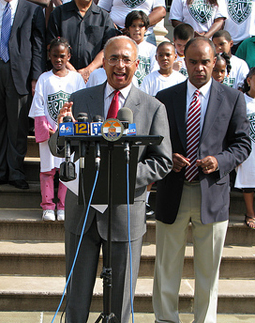
Thompson may turn in that reserved, demure demeanor for a megaphone. He's turning to populism and outrage to get him elected as the city's second African American mayor.
"I think that he set out four years ago when he was entering the last term as comptroller to see himself as a future mayor," said Ken Fisher, a former member of the City Council and unsuccessful borough president candidate. "I think he's running for the right reasons. He is pretty realistic about how difficult it is to unseat any incumbent mayor, let alone one with good favorables and unlimited resources."
So far, the Thompson campaign has had varying success.
His Base
In a dark, damp, practically windowless American Legion hall in the Bronx several weeks ago, scores of attendees wait for the Democratic contender for mayor. The event's host, Assemblymember Peter Rivera, is about to dole out the first endorsement of Thompson's campaign.
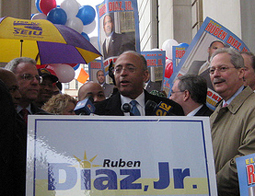
Moments later, the candidate enters. He addresses the crowd for about 20 minutes, attempting to silence the skepticism -- in and outside of the room -- about his ability to win. "How do you beat Mike Bloomberg?" Thompson asks, with greater force in his voice than most have seen from him before. "With all these people around this room," he says drawing circles in the crowd with his finger.
"That's right," they respond, many clapping.
"With your help," Thompson says, still pointing at supporters. "And your help, and your help."
But for Thompson, it's going to take a lot more than attending rallies. The latest Quinnipiac University poll numbers show Bloomberg beating Thompson 49 percent to 35 percent. Among African American voters, who many consider to be Thompson's base, only 44 percent know enough about the candidate to form an opinion. Only 28 percent of Democrats who know who Thompson is have a favorable opinion of him.
The mayor's approval rating, as of March, was at 64 percent. Even with increased property taxes and reduced services, a divisive term limits battle and a proposal to raise the sales tax, Bloomberg, say political observers, is practically unbeatable. He has already spent about $7.5 million, which is more than Thompson can spend for the entire primary if he participates in public financing.
Well-produced commercials flood the airwaves with the mayor spouting "jobs, jobs, jobs," while Thompson has had only one web-only campaign commercial, which resembles more of a home movie than high-tech voter solicitation. Thompson may be loading his schedule up every night -- floating from Democratic club to Democratic club across the boroughs -- but voters, say observers, haven't really seen him.
"The problem for Bill is what he's done in the past eight years," said consultant George Arzt. "He's not been highly visible. It's tough to make it up in such a short span between now and the election."

That lack of visibility -- no matter how powerful the rhetoric was -- wafted through Midtown's Hilton Hotel last month. More than 100 members of International Brotherhood of Teamsters Local 237 were stretched out throughout the scores of circular tables in the Grand Ballroom. Bill Thompson was at the podium, delivering a well-rehearsed stump speech meant to trigger the memory of Election Day 2008 (both for term limit and Barack Obama purposes).
His address was greeted by applause, but to some attendees, Thompson stands out no more than Tony Avella.
After asking Thompson about his position on new pension benefits, George Purdy, a masonry worker for the New York City Housing Authority for more than 30 years, said he thought both Democratic candidates "were on the same tier."
With so little name recognition, Thompson's best chance, said Arzt, is stressing Bloomberg's "negatives." "Pound away" at the increased taxes, convince the public that it's Bloomberg who is responsible, and maybe he can make it work, Arzt said.
"This election will be about Mike Bloomberg," said City Councilmember Lewis Fidler of Brooklyn. "Bill Thompson will pass the acceptable test with flying colors. He really has no real negatives. He is the consummate gentleman. The word they use in my neighborhood is mench."
But, added Fidler, to win -- in his mind not an impossible feat -- Thompson needs to take it negative.
"He's got to make every dollar work against the mayor by having people feel their opinion is being bought," added Fidler. "Make people question the platitudes that are written, like 'the schools are better,' that 'Mike Bloomberg got us through this financial crisis.'"
So far, Thompson has put out only one detailed policy proposal, and that is on mayoral control of schools, which he supports but would like altered to provide for more parental involvement. Thompson, who opposes an increase in the sales tax, also suggested raising the personal income tax on the city's top earners. He backed away from that proposal after the state approved a similar one.
Thompson has balked at taking a position on the creation of another pension tier, which could reduce pension benefits for new city employees, saying such proposals should be discussed behind closed doors with union leaders and officials and not in the press.
In an interview with Gotham Gazette, Thompson said the city should boost small business to help the economy. When asked for more details on how he would revitalize the economy, Thompson said, small business cannot fill the hole left by the devastation of Wall Street, but it can plug some of it. More recently, the candidate said he would release his own proposals to deal with the city's budget deficit, and they would not include increasing the sales tax.
But in a subtle transformation from city financier to mayoral candidate, Thompson has started to use his office as a pulpit for his campaign and as a hub of Bloomberg criticism. Just last week, the comptroller called for the resignation of a mayoral appointee over a column in the Huffington Post -- a stance some said was beyond the purview of the comptroller's office. He has ramped up his criticism of the Yankee Stadium deals and thrown bricks over no-bid contracts at the Department of Education.
Back to Nutter and Dinkins
Thompson is no stranger to challenges. Much of his political life has been playing the unassuming underdog with a bigger bite than expected.
"Never undersell Bill Thompson," said Democratic political consultant Hank Sheinkopf, who is currently on the Bloomberg '09 payroll. "He is extraordinarily smart. He is very capable… He's the best inside player."
But compliments don't bring voter confidence. Sheinkopf is a perfect example. He led Thompson's campaign for comptroller in 2001, but went with Bloomberg's team this year. He said the decision to go with Bloomberg was something he "discussed at length" with both sides.
Starting out a race to become New York City's chief executive by losing allies does not bode well.
Nonetheless, both sides of the campaign argue, "Never say never."
Initially, Thompson supporters thought he could pull the next "David Dinkins" -- bringing together a coalition of black and Hispanic voters to snatch the mayoral post. Part of his initial election as comptroller, the first elected office he has held, came on the back of Fernando Ferrer, who while seeking the Democratic line for mayor brought out a lot of Hispanic and black voters.
With Dinkins, however, the city's race relations were on a tumultuous footing. Some of Bloomberg's harshest critics still credit the mayor for really bridging the racial divide in the city. Though many agree that Thompson would need a coalition of black and Hispanic voters, they say that might not be enough to take down a widely popular incumbent.
Additional help may come from Philadelphia. With a drought of consultants here (the current mayor has snatched up a lot of the good political operatives with his infinite payroll), Thompson is tapping political consultants who ran the campaign of Michael Nutter, the underdog-turned mayor of Philadelphia. Ed Peavy of Mission Control, a direct mailing firm, and others rumored to be with Thompson are said to be responsible for Nutter's near impossible win.
Maybe they will work their magic here.
A Spreading Scandal
For nearly three decades in the political arena, Thompson has steered clear of scandal. But the growing inquiry into the dealings of the state and city pension funds, centered around a firm run by former State Senator Daniel Hevesi, could provide opponents with ammunition to link Thompson with mismanagement.
Talk about bad timing.
Thompson has not been linked to any wrongdoing. He actually requested that state Attorney General Andrew Cuomo investigate his office to "clear the air." The city's pension system is also run differently than the state's. Its investments are approved by a board, not a single individual. As a result of the inquiry, Thompson called for the city to ban the use of intermediary firms, which help broker deals on pension investments.
Not withstanding, Thompson's campaign account may have benefited from his role as city financial steward.
A review of the investment firms that have been approved as consultants to the city's pension funds for fiscal year 2008 shows that employees of at least six firms have contributed to Thompson's campaign account, totaling about $10,000 in funding. Some of the firms include Advent and RRE Venture, both located in New York, and the now extinct Lehman Brothers. In all but one case, Advent, the companies had a contract to advise the city on pension fund investments before contributing to the Thompson campaign. These firms made nearly $5 million in advising the city in fiscal year 2008.
In an e-mail, the comptroller's Communication Director Jeff Simmons said, "The Comptroller's Office's Bureau of Asset Management assists the pension funds in selecting investment advisors and consultants. There is a wall between the operations of this office and the external campaign activities you are referring to, such that [bureau] staffers have no awareness of those activities. Political favors absolutely do not play any role in the process."
Thompson has also received a $2,500 contribution in 2007 from the now indicted former Liberal Party head Ray Harding and a $4,950 contribution in 2006 from William Howell, whose role in the pension scandal has been targeted by the Village Voice.
Overall, Thompson has raised about $3.75 million so far for his mayoral run (about $1.5 million less than what Weiner's non candidacy has garnered). In addition, Thompson has rolled over about $1.5 million from his previous comptroller run, giving him more than $5 million to work with. Since the term limit extension was approved last November, Thompson has raised a little more than $96,000.
So far, the comptroller has spent about $1.4 million, of which more than 60 percent has gone toward campaign consulting. Since Thompson appeared to emerge as the only viable Democratic candidate, his spending has slowly increased, averaging about $11,166 a week for the first three months of the year, while it was about $9,522 a week in 2008.
Of the $36,000 he has spent on advertising so far, the vast majority has gone to local civic groups or Democratic club journals with minimal readership.
The latest campaign finance filings are due out this Friday.
Support Gaining Momentum
About 20 supporters gathered around a podium in the West Village late last month, holding "Bill Thompson: Democrat for Mayor" blue signs -- the candidate's name below the city's iconic skyline.
Turnout was light. One sign holder was overheard confusing the mayoral candidate with the state's comptroller, Thomas DiNapoli. A staffer corrected him.
Thompson was there to accept the endorsements of several Manhattan-based state Assembly and Senate members. Two of them did not appear at the event. A call later to State Sen. Eric Schneiderman's office revealed there had been a "mix-up" and he was not scheduled to attend, though he had endorsed Bill Thompson for mayor earlier.
The two state leaders who did show up, Assembly members Micah Kellner and Deborah Glick, spoke of Thompson's candidacy with emphatic optimism.
"I am reminded of the contraction of social services that we faced under Giuliani," Glick said of Bloomberg's latest budget proposal. "The notion that people will simply disappear if you prevent them from having life saving services was wrong then and it is wrong now. And I am proud to be standing here with Bill Thompson, who I hope will be, and I'm confident that by the time people review the record will be the next mayor of the city of New York."
Some city officials, like Assemblymember Annette Robinson, say they have already endorsed Thompson. But nary has a word seeped out about it from Thompson's campaign headquarters.
But even with that support, Bloomberg has already garnered about seven times as many endorsements as Thompson -- and some of them from Democrats. On Saturday, the mayor landed the influential endorsements of the Rev. Floyd Flake and Democratic Assemblymember Barbara Clark, both of Queens.
"I think Bill is a great candidate," said John J. Ciafone, executive president of the Aldo's Democratic Club in Astoria, which recently endorsed Bloomberg and has about 250 members. "I think that comparing him to Bloomberg, he's not ready. We feel like he needs to wait four more years."
Thompson says he isn't worried about the amount of endorsements he has or doesn't have. Back in his fifth floor office Downtown, where books about Harlem grace his coffee table (a likely tribute to his new home in Manhattan), Thompson exudes a muted confidence over the battle that lies ahead.
He says over the next six months his campaign will just keep gaining momentum. "I am comfortable with where I am at right now," Thompson explains.
But no one ever said being cozy wins elections.