The new Museum of Modern Art is nearly double the size of the old one, and cost $425 million to construct. |
The Museum of Modern Art was founded in 1929 by three remarkable women including Abby Aldrich Rockefeller. They had what was then and still is a very simple and a very compelling idea, which is that modern art is the art of our time and is every bit as compelling and interesting as the art of the past. And that New York City because it is the city of the future - and certainly was seen as a city of the future in 1929 --should be the premiere place in the world to see, enjoy, and learn about modern art.
That idea has propelled the institution forward from rented space on Fifth Avenue -- 4,000 square feet in the Heckscher Building, now the Crown Building - to our new home that we opened to the public on November 20. The project, designed by Yoshio Taniguchi, was really the result of over a year of reflection and discussion within the institution. We called it "Imagining the Future," when we and the staff and trustees asked ourselves and our friends what it was that we needed to succeed in the 21st century as well as we had in the 20th century. It became very clear that what we needed first and foremost was an architectural platform that would allow the ideas of the institution to be expressed in a new and different way. We needed more space for contemporary art, a completely different layout of the galleries that was more complex, nuanced, and the conversion of the building as an entity from a kind of hermeneutic box that turns inward away from the city into a pulsing center of activity that opened out onto the city.
In 1939, when our first building was created specifically for the museum by architects Philip Goodwin and Edward Stone, we were the first urban museum that opened directly onto the street, that captured the beat, the energy, the pulse of this extraordinary city, and we wanted to regain that, something that had been lost over the intervening decades.
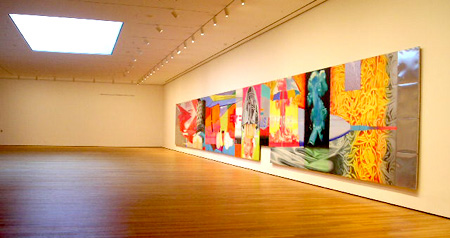
The new, cavernous sixth floor offers temporary exhibitions. Here, "F-111" by James Rosenquist.
So under the remarkable chairmanship of David Rockefeller in our capital campaign, we set out to literally remake the Museum of Modern Art. It involved first of all what we thought would be a capital campaign of $300 million, and I have to confess that the head of development and I looked at $300 million and said, "How could that possibly be? There’s no way."
But by the time we convened a group of remarkable people to work with us on this project, and Yoshio’s plans crystallized, and we realized what the scope of we were going to do would involve, we had a capital campaign of $858 million. The core group of "founders" -- individuals that we had attracted to this project to be part of the remaking of the Museum of Modern Art and that now numbers 55 -- each have given in excess of $5 million. We currently have $725 million raised or pledged.
|
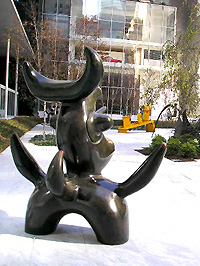
The Abby Aldrich Rockefeller Sculpture Garden has been expanded and features 31 works from the collection. |
What is the project? The project is a $425 million rebuilding of the museum here in Manhattan, $120 million to enable our endowment to sustain operations, and $100 million for future real estate acquisitions. We bought a great deal of land around the museum and in Queens in order to ensure that the next generation of the museum has the space in which to continue. We put $50 million into a kind of a rainy-day fund to help our operation when we were under construction, then we built MoMA QNS, a study and storage center in Long Island City, which we used for a little over two years for temporary exhibitions while we were under construction in Manhattan.
None of this -- absolutely none of this -- would have been possible without catalytic support of the city and then the state. Then-Mayor Rudy Giuliani gave us a $65 million grant that the current administration has ardently supported. Without that seed funding, we could never have launched a capital campaign on this scale. The city was joined by the state, which has now given us $10 million from the governor’s office. That vote of confidence is what allowed us to go out to the private sector and say, "Look, if the city and state have walked into this project at this scale, we really hope that you will match that and exceed it."
Our original hope had been that we could match the city money ten to one. We have far outdone that. By the time this project is through, it will be more like twelve and a half to one.
|
The fifth floor features selections from the museum's sculptures and paintings collection. On the outside wall, "Rhythm of a Russian Dance" by Theo Van Doesburg (1918); in the distant gallery, "Head of A Woman" by Pablo Picasso (1932) |

What I think is critical to understanding why this project has at least made it to where it is is that the museum has always understood a very simple formula, which was that to be an outstanding museum meant having an outstanding collection. Nothing mattered more to the Museum of Modern Art than a singularly important collection.
In order to have a singularly important collection, two factors have to be at play simultaneously and always. The first is an extraordinary board of trustees utterly dedicated and committed to the museum’s mission. The second is an outstanding staff capable of doing the research and creating the support mechanisms and the educational programs to enable the development of an extraordinary collection and ultimately its display to the public.
While I think one can make very strong economic benefit arguments for why the museum’s expansion is beneficial to the city and the state -- and we made those arguments and were very gratified by the city and state’s recognition of the inherent value that cultural institutions play in the vibrancy of New York City and state -- ultimately, the reason we can make those economic arguments is precisely because of the singular importance of the institution as an artistic venue. By that relentless commitment that now extends over three or four generations striving to build an outstanding collection and developing innovative ways of displaying it, the institution has garnered both a considerable public -- approximately 1.8 million people before we began shutting down for the construction project -- and a considerable critical public. That creates a kind of magnetic effect that enables us to look to the future with some degree of confidence.
|
A model of the new Museum of Modern Art as part of an exhibition in the new Museum of Modern Art on nine museums designed by architect Yoshio Taniguchi. |

In a post-9/11 environment I think it is impossible to predict precisely what kind of attendance the museum is likely to generate. Certainly I think it would be foolhardy to assume one can continue on the same path at least on the short term that propelled so many cultural institutions pre-2001 toward a sense of continual growth. We were seeing our audiences grow at five or ten percent every year for seven or eight years in a row. But I do think that this city supports the arts like no other city in America. I do think that the aggregation of cultural institutions in the city makes New York a unique place. And it is the synergy between our institutions that enables us collectively to be bold and adventuresome about the kinds of projects we undertake.
In our case as we open to the public and look to the end of our capital campaign, we are already thinking about the next moves. For us, the construction of this building was not an end but a beginning.
It is now the platform for us to work through the next set of ideas about the Museum of Modern Art as an institution that we would like to think of as isotopic with a series of half lives constantly evolving, constantly changing. What you will see in the new museum is a proposition, an idea about to how perceive and enjoy and appreciate modern art that will change continually. As it changes, so too will the building and so too will our needs. If we have done our job well, we will continue to be a very young institution despite our 75 years.
Glenn Lowry has been the director of the Museum of Modern Art since 1995.
Related Stories:
• Barry Grove: The Manhattan Theater Club Revamps a Legendary Theater
• Paul Kellogg: Seeking a New Space for the New York City Opera
•
Glenn Lowry: The Museum of Modern Arts' New Home
• Linda Shelton: Creating a Center for Dance in Lower Manhattan