New York Should Amend the Law Requiring Police Disciplinary Cases Be Tried Within the Police Department
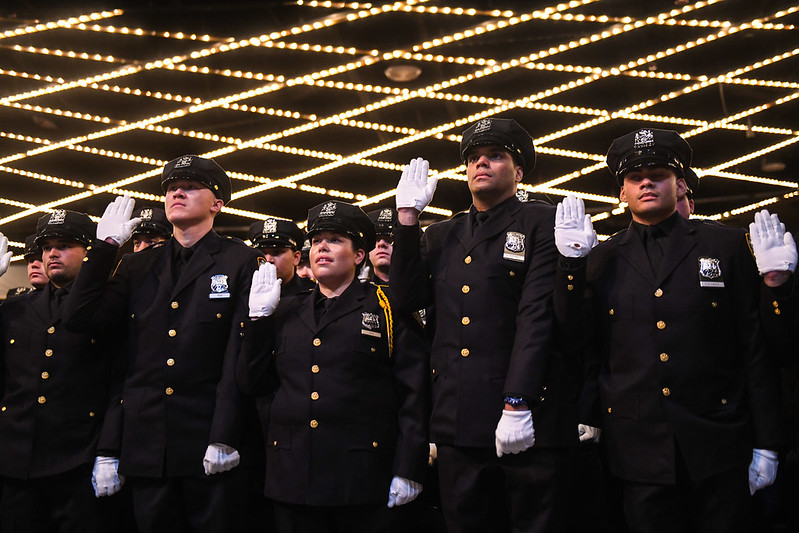
NYPD officers (photo: Michael Appleton/Mayoral Photography)
This guest column is part of Citizens Union Speakers, a regular series of op-eds written by members of the Citizens Union Foundation community in Gotham Gazette, CUF's flagship public education program. The opinions expressed in these Citizens Union Speakers columns are those of the authors alone, not Citizens Union Foundation, Gotham Gazette, or any other entity.
* * * * * * * * * * * * * * * * * * * *
During its most recent session, the State Legislature enacted and the Governor signed a number of important reforms relating to police misconduct, most notably the repeal of Section 50-a of the Civil Rights Law, which prevented disclosure of any documents relating to the disciplinary records of police officers. Another law, however, which remains in effect, requires disciplinary hearings against police officers to be heard within the police department and thus prohibits such hearings to be conducted before an independent tribunal. The Legislature should amend the law to remove that prohibition.
New York State Unconsolidated Laws Section 891, which dates back to 1940, provides the procedures for the removal of police officers “serving in the competitive class of civil service in any city, county, town or village of the state.” One of its provisions states: “Hearings upon charges pursuant to this act shall be held by the officer or body having the power to remove the person charged with incompetency or misconduct or by a deputy or other employee of such officer or body designated in writing for that purpose.”
Although the statute deals with procedures for the removal of a police officer, one appellate court has ruled that it prohibits any disciplinary proceeding from being heard outside of the police department, whether or not the penalty of termination is sought or is a possible outcome of the process. See Lynch v. Giuliani, 301 A.D.2d 351, 356-57 (1st Dept. 2003). The history of that case is instructive.
In 2001, during the last year of the Giuliani administration, the New York Police Department entered into a Memorandum of Understanding with the Civilian Complaint Review Board whereby the CCRB was delegated exclusive authority to prosecute cases in which it had substantiated the charges and specifications. The MOU also provided that hearings on those matters would take place before the Office of Administrative Tribunals and Hearings rather than within the NYPD. The Police Benevolent Association, led by Patrick Lynch, sued to challenge the validity of the MOU with its primary focus on the delegation of the prosecutorial function to the CCRB; however, the lawsuit also challenged the transfer of hearings to OATH.
The lower court upheld both provisions but modified the latter, holding that because of Section 891, any case in which termination was a possibility had to be heard within the NYPD. The Appellate Division affirmed the holding that delegation of prosecutorial authority to the CCRB was lawful, but reversed with regard to hearings before OATH, ruling that all such matters must be heard within the NYPD whether or not termination was a possible outcome of the disciplinary process. Neither party appealed.
As a result, all disciplinary proceedings against police officers continue to be heard within the NYPD before administrative hearing officers who are appointed by the Police Commissioner and serve at the commissioner’s pleasure. This is in contrast to all other New York City agencies for which disciplinary cases against employees (including uniformed employees) are heard before OATH judges who serve for fixed terms and are not answerable to the agency head whose employees are the subject of the hearing. Thus, the officials within the NYPD who hear and make recommendations with respect to disciplinary cases against police officers lack the independence and job security of the administrative law judges within OATH who hear and decide such matters in disciplinary cases involving all other city employees.
This is not to suggest that the NYPD administrative hearings officers are not persons of quality. Some are outstanding. Most notably, Rosemary Maldonado, the Deputy Commissioner of Trials, conducted a fair and dignified hearing of the case of Daniel Pantaleo, the police officer whose chokehold resulted in the death of Eric Garner, and issued a thorough and balanced report that recommended his termination. However, the proper handling of one high-profile disciplinary proceeding does not obviate the structural flaw in the system. Public confidence in the disciplinary process would be enhanced if the disciplinary hearings for police officers, like those for all other city employees, were conducted before the independent administrative law judges of OATH rather than within the NYPD.
In order to achieve that result, the State Legislature should amend Section 891 to remove the sentence requiring police disciplinary hearings to be conducted within the police department.
***
Frederick P. Schaffer is a Director of Citizens Union Foundation.
This guest column is part of Citizens Union Speakers, a regular series of op-eds written by members of the Citizens Union Foundation community in Gotham Gazette, CUF's flagship public education program. The opinions expressed in these Citizens Union Speakers columns are those of the authors alone, not Citizens Union Foundation, Gotham Gazette, or any other entity.
* * * * * * * * * * * * * * * * * * * *
11 Keys to Make Policing Work
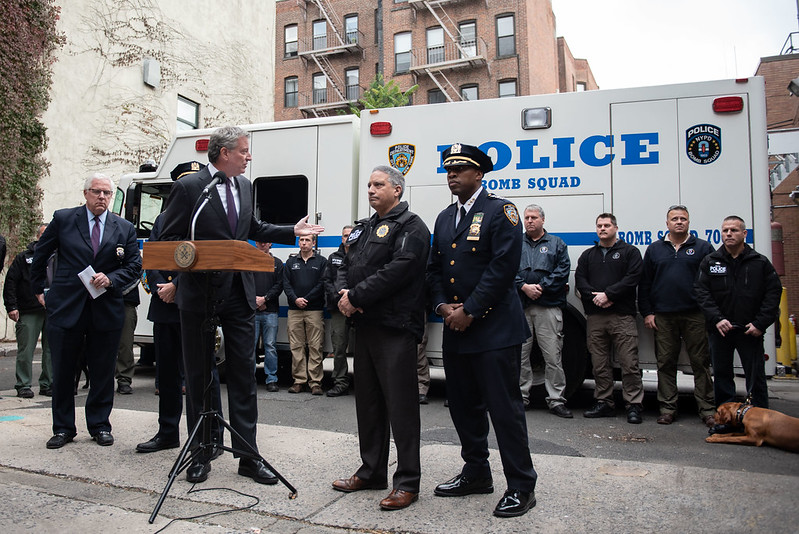
Mayor de Blasio and the NYPD (photo: Michael Appleton/Mayor's Office)
This guest column is part of Citizens Union Speakers, a regular series of op-eds written by members of the Citizens Union Foundation community in Gotham Gazette, CUF's flagship public education program. The opinions expressed in these Citizens Union Speakers columns are those of the authors alone, not Citizens Union Foundation, Gotham Gazette, or any other entity.
* * * * * * * * * * * * * * * * * * * *
When considering the requirements for effective policing I am reminded of two of my experiences.
First, I served on a commission to review the operations of the Philadelphia Police Department after the departure of Mayor Frank Rizzo, a man whose approach both in that office and in his prior role as Police Commissioner could be fairly thought of as racist. Among the core findings of that commission was that the Police Department had consistently devoted insufficient resources to policing minority communities, and instead focused on the safety of the business district and other neighborhoods.
Then in the early 1990s I was working with communities of color in the area surrounding the northern part of New York City’s Central Park on public safety issues by, among other things, organizing meetings between local residents and local police officials. At one of these meetings a woman got up and in a strong voice made two points: she first complained about local patrol officers spending too much time in the safest places (eg, in front of churches) rather than actively patrolling higher risk areas, and second she complained about the police harassing her teenage son.
She was right — everyone is entitled to a police department that both works to provide them with the benefits of living in a safe neighborhood and, as the Black Lives Matter movement so justifiably demands, neither abuses nor discriminates against anyone. And public policy needs to advance both goals by promoting reform without sacrificing safety.
There have been numerous studies of policing, but without the need for still more commissions there are certain things that plainly are necessary components of effective policing, including the following;
1. Have clear standards of conduct. When the rules are clear it benefits police officers and the public. Those rules, however, must reflect the realities that good police officers may confront. Thus, for example, there should be a ban on chokeholds, but there also should be an exception for when the officer would be entitled to fire his weapon under a use of force standard. Putting a knee on someone’s throat as a means of restraint, as was done to George Floyd, is plainly wrong, but briefly putting one’s knee on someone’s throat in a struggle over a gun is very different.
2. Ban arrest and summons quotas. Quotas are unfair to officers and incentivize questionable police actions.
3. Monitor problem officers. It is important to monitor officers with large numbers of complaints, even where they all do not produce adjudicated findings of wrongdoing. While a large number of complaints may be made against an officer in retaliation for an officer simply effectively doing his or her job, the opposite may also be true. Thus, requiring that the conduct of officers with a defined number of complaints be reviewed in a non-disciplinary context could lead to retraining, reassignment, a pointed conversation with a precinct commander, or no action at all.
4. Training is essential. Not only does there generally need to be effective in-service training, but, as some police departments are doing, there needs to be extensive de-escalation training. Police officers generally are taught that they need to maintain control of all situations; they need to learn how sometimes the right answer is de-escalating, particularly when dealing with non-serious offenses or with people exhibiting signs of mental illness. Rookies also should not be assigned to training officers who have been the recipients of large numbers of complaints, which was what happened with the new officers in the George Floyd case.
5. An effective disciplinary system improves the force. Disciplinary systems need to be fair to the officers but also transparent to the public, so that how a department is addressing wrongdoing is not a secret. They also need to be timely. In serious cases police departments often agree to requests from prosecutors to await the conclusion of criminal proceedings before acting. But when, as in the Eric Garner case that produced a five-year delay, the process moves slowly, confidence in the police department is undermined. Reasonable time limits thus need to be put on these agreements to delay.
6. Pursue diversity. It is important that police forces reflect the communities they serve so they do not have the appearance of an occupying army.
7. Community engagement helps. As discussed in the Obama Administration’s report on Policing in the 21st Century, police officers and the community should interact outside the enforcement context. Activities could include youth police academies, a structure to include police and community leaders in the development of approaches to local crime problems, youth programs, and more.
8. Encourage restorative justice. Non-arrest approaches should be used to deal with minor offenses, particularly involving young people .
9. Use technology. Expanding the use of body cameras not only can protect against police abuses, but can help defeat wrongful complaints against officers.
10. Limit qualified immunity. Police officers should only have the ability to avoid having to defend the appropriateness of their conduct under the qualified immunity doctrine if they comply with all applicable standards of conduct.
11. Carefully evaluate police funding. Putting aside the political wisdom of using “defund the police” as a slogan, it is not the way to address police funding from a policy perspective. While police departments cannot be immune from budget cuts during a fiscal crisis, in general we need to decide what we want the police to do and fund them accordingly. More police officers on the streets, for example, was one of the reasons crime was reduced in New York City in the 1990s.
If we want enhanced training, better supervision, enough officers out in the community, protection against terrorist attacks, and more, we need to provide appropriate levels of funding. The real answer is not just reducing police budgets, but making sure we adequately fund mental health and drug treatment programs, jobs programs, homeless prevention programs, and the like. Making more people feel that their needs are being addressed and that they have a stake in society means fewer people will resort to crime.
Having police forces that both protect residents’ safety and their other rights is not easy. It is, however, essential. Indeed, having a criminal justice system that is commonly believed to be fair is critical if we want the public to accept the outcomes of that system as legitimate.
***
Richard J. Davis served Assistant Secretary of the Treasury for Enforcement and Operations (1977-81) and Chair of the New York Commission to Combat Police Corruption (1996-2001).
***
Have an op-ed idea or submission for Gotham Gazette? Email This email address is being protected from spambots. You need JavaScript enabled to view it.
***
This guest column is part of Citizens Union Speakers, a regular series of op-eds written by members of the Citizens Union Foundation community in Gotham Gazette, CUF's flagship public education program. The opinions expressed in these Citizens Union Speakers columns are those of the authors alone, not Citizens Union Foundation, Gotham Gazette, or any other entity.
* * * * * * * * * * * * * * * * * * * *
This guest column is part of Citizens Union Speakers, a regular series of op-eds written by members of the Citizens Union Foundation community in Gotham Gazette, CUF's flagship public education program. The opinions expressed in these Citizens Union Speakers columns are those of the authors alone, not Citizens Union Foundation, Gotham Gazette, or any other entity.
* * * * * * * * * * * * * * * * * * * *
No, Trump Can’t Postpone the Election, But Congress Needs to Fund It

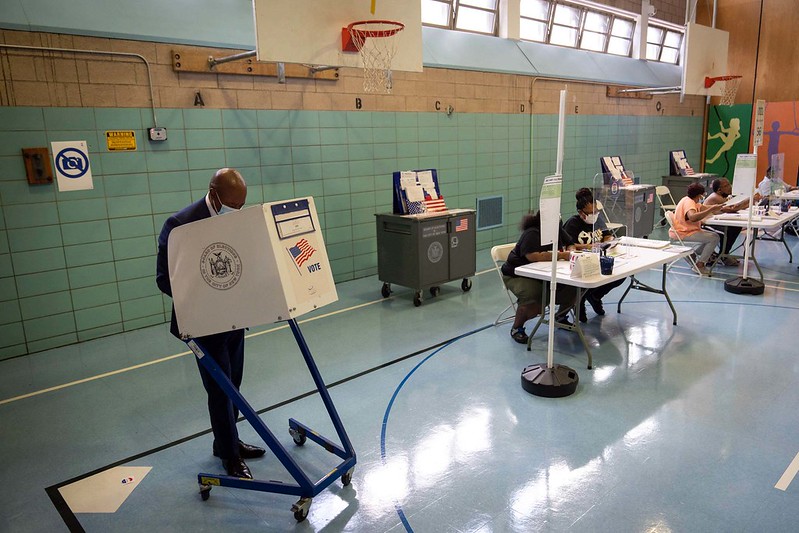
Electors to the Electoral College voting in Albany (photo: governor's office)
This guest column is part of Citizens Union Speakers, a regular series of op-eds written by members of the Citizens Union Foundation community in Gotham Gazette, CUF's flagship public education program. The opinions expressed in these Citizens Union Speakers columns are those of the authors alone, not Citizens Union Foundation, Gotham Gazette, or any other entity.
* * * * * * * * * * * * * * * * * * * *
In a tweet posted at 8:46 a.m. on July 30, President Trump floated the idea of postponing this fall’s general election. Once again making baseless charges against the integrity of mail-in voting, Trump tweeted – the three question marks are his – “Delay the Election until people can properly, securely and safely vote???” Well, Trump cannot postpone the election. There is no reason to postpone the election. But Congress must act to assure the legitimacy of this fall’s vote.
First, and most importantly, the President has no power to set, modify, or alter the date of the election. That date – which governs elections for the Senate and House of Representatives as well as for President – is set by Congress. Since 1875, that date, as we all know, is the Tuesday after the first Monday in November, which this year is November 3.
With respect to the Presidency, Congress has further elaborated by statute the schedule for the casting and counting of the votes by the Electoral College, which, as we were reminded in 2000 and again in 2016, actually picks the President. By law, the electors are required to meet in their home states and cast their votes on the first Monday after the second Wednesday in December, which this year is December 14.
By law, Congress meets on January 6 to count the electoral votes, declare a winner, or resolve any disputes. And under the Constitution, the President’s term ends at noon on January 20, 2021. Any change to Election Day or the schedule for the casting and counting of electoral votes would require an act of Congress. Any change to the expiration of the presidential term would require a constitutional amendment. The first, which would require approval by the Democratic House of Representatives, is extremely unlikely. The second, which would require approval by two-thirds of both houses of Congress and three-quarters of the states, is virtually impossible.
The President has no national emergency power to stop or reschedule the election. As just noted, the election dates are determined by Congress and the actual operation of the election is conducted by the states and local governments, subject to congressional revision. The President has no power to change that.
Second, there is no reason to postpone the election, even if at this stage it were legally possible. COVID-19 is surely a hugely disruptive and tragic event, but we have stuck to the electoral schedule during even greater crises. Presidential and congressional elections were held as scheduled in 1864, at the height of the Civil War. Indeed, absentee voting was first pioneered during the Civil War to allow Union army soldiers to vote from the battle front.
Presidential and congressional elections were again held as scheduled in 1944, during the peak of fighting during World War II, with millions of soldiers around the world able to participate. And the congressional elections of 1918 were held as scheduled even as both the influenza pandemic and World War I raged.
Regularly scheduled elections are perhaps the most important feature of our democracy. Like past disasters, COVID-19 is a challenge to be addressed, not an excuse for cancelling democracy.
Third, however, it will require action by Congress for the COVID-19 election to succeed. Despite the president’s tweets, vote-by-mail has a proven track record of integrity and effectiveness. Even before COVID-19, roughly 20 percent of ballots cast in recent federal elections were submitted by mail, and in five states elections are conducted virtually entirely by mail. But these states took time to transition from polling-place voting to address some of the problems mail-in voting raises, including verifying signatures, getting ballots out and back on time, and tabulating the results.
The unprecedented surge in mail-in voting in place of traditional voting in primaries this spring and summer raised a lot of these problems in states around the country. Dealing with them will require getting and testing new equipment, training election workers, preparing the postal service, and educating voters. All this will require a major administrative effort by state and local election administrators, and it will also require money.
Congress is currently struggling over the latest COVID relief bill. The House bill – passed in May – offers states and local governments $3.6 billion in election assistance funds, which are essential for smoothing the transition to mail-in voting as well as for proving election administrators with the money necessary to make polling places safe and sanitary for the many millions of voters who will want to vote in person, whether at early voting election centers or at polling places on Election Day. The latest Senate Republican proposal has NO money for election assistance.
It is certainly understandable why Congress should focus its concern on the unemployed, small business, and essential workers. But democracy is also essential, and surely a few billion of the trillion dollars or more than Congress will eventually appropriate must be allocated to protecting democracy.
Congress’ failure to appropriate the funds needed to pay for the transition to mail voting and making polling places safe and sanitary would mark a greater threat to the legitimacy of the 2020 election than any of the president’s tweets.
***
Richard Briffault is the Joseph P. Chamberlain Professor of Legislation at Columbia Law School and Vice Chair of Citizens Union Foundation.
***
Have an op-ed idea or submission for Gotham Gazette? Email This email address is being protected from spambots. You need JavaScript enabled to view it.
***
This guest column is part of Citizens Union Speakers, a regular series of op-eds written by members of the Citizens Union Foundation community in Gotham Gazette, CUF's flagship public education program. The opinions expressed in these Citizens Union Speakers columns are those of the authors alone, not Citizens Union Foundation, Gotham Gazette, or any other entity.
* * * * * * * * * * * * * * * * * * * *

|
Tweet |