An Overdue Answer to Terror Lynchings and the Racial Psychopathy of ‘White Supremacy’
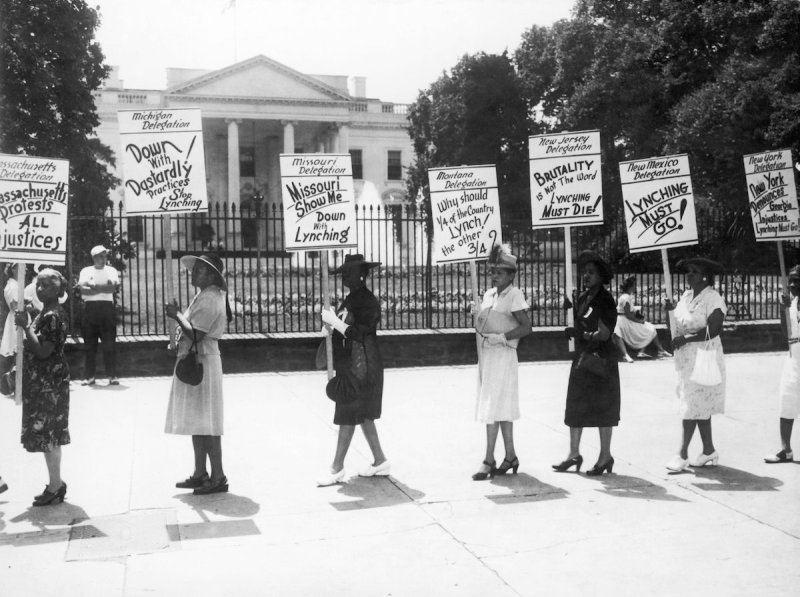
An anti-lynching protest in front of the White House (Library of Congress)
This guest column is part of Citizens Union Speakers, a regular series of op-eds written by members of the Citizens Union Foundation community in Gotham Gazette, CUF's flagship public education program. The opinions expressed in these Citizens Union Speakers columns are those of the authors alone, not Citizens Union Foundation, Gotham Gazette, or any other entity.
* * * * * * * * * * * * * * * * * * * *
Warning: this article contains graphic descriptions of racist violence.
For more than 300 years, major segments of our nation—oftentimes with the full support and backing of our government, including federal, state, and local governments and law enforcement—have advanced the corrosive and twisted cause of white supremacy. These efforts have taken many forms, far too numerous to document here. But, unmistakably, these efforts have included systemic and institutionalized violence against the Black community to assert white superiority and Black inferiority. No campaign was more evil, nor more cruelly effective, than terror lynchings between 1887 and 1950.
Even well-meaning white people reflect on this history of lynchings, slavery, Jim Crow-ism, and segregation with the misguided belief that things are much different now. Yet, legions of Black men and women have been murdered by the police, and even more lives and families have been destroyed by mass incarceration of Black Americans. Recently in Rochester, New York—in the heartland of the allegedly enlightened North—a gang of racists tore down a statue of Frederick Douglass and threw it in a gully. Our Congress cannot even seem to pass an anti-lynching law after more than 100 years of trying. Against this background, we have a president whose administration panders to, and foments, violent and emergent white supremacist groups, including its former Chief Strategist, Steve Bannon, who infamously told a crowd in 2018, “Let them call you racist…wear it as a badge of honor.”
“The way to right wrongs,” as so eloquently put by anti-lynching activist Ida B. Wells, “is to shine the light of truth upon them.” But, the truth of terror lynchings is very hard to read. In public discourse, there should always be a reason for the graphic tellings of violence, lest we succumb to exploitation and the pornography of atrocity. Here, the purpose of horrific accounts is in service of an important point, which is often missed in our public debate over race and equality in America: white supremacy is a demonstrable form of clinical psychopathy. Three stories animate, with brutal clarity, the psychopathy of white supremacy, and the racial poison it infused into our culture.
On August 6, 1930, in Marion, Indiana, three young Black men, Tom Shipp, 19, Abe Smith, 18, and James Cameron, 16, had been arrested for the murder of a white man and the rape of a white woman (who later recanted and denied being raped). A mob gathered at the jailhouse, where the police chief had hung the bloody shirt of the murdered man on the façade of the building, drawing a crowd that swelled to more than 5,000 people. The mob—which included local sheriff’s deputies— broke through the front door of the jail with sledgehammers and pulled the boys out into the street, savagely beating them with clubs, bricks and crowbars. One white man thrust a crowbar through Shipp’s stomach over and over, and then put a noose around his neck and hung him from the bars over the jail’s windows. Other members of the mob beat Smith mercilessly as he fought for his life amid the public spectacle. As the mob hauled him to a maple tree in the courthouse square, Smith tried to remove the rope. Undaunted, members of the mob stabbed him and broke his arms. A frenzied crowd of men, women and children cheered as Smith fought on, trying to free himself until the mob finally killed him. The youngest victim, Cameron, who looked too slight and young to be even 16, was spared the rope when a single onlooker protested his innocence. The crowd took Shipp’s body from the front of the jail and hung him next to Smith’s lifeless cadaver. The event took on a carnival-like atmosphere, with white school kids on lunch break joining the crowd. A photographer chronicled the event and later sold the photographs as souvenirs. Despite efforts from the NAACP and the State’s Attorney General to bring charges against members of the mob—who were readily identifiable in the photographs—no one was ever prosecuted for these brutal, public murders.
On May 15, 1916, an angry mob in Waco, Texas lynched a 17-year-old farmhand named Jesse Washington. Like so many other lynching victims, Washington had been accused of raping and murdering a white woman. Illiterate and mentally disabled, Washington was forced to place his mark on a confession he could not read. An all-white jury found him guilty in four minutes. After the conviction, a mob dragged him out of the courthouse by a chain fastened around his neck. On the way to a tree in the public square, the crowd beat and stabbed him as he gripped the chain to relieve the pressure on his neck. At the foot of the tree, the crowd held him down while one member castrated him with a large knife, and then hauled him up on a branch and lit a fire under his feet. As the mob raised and lowered him over the fire, Washington struggled to pull his body up in the chain. The mob lowered him down and cut off his fingers. They burned him alive over the fire for more than an hour as the large crowd, with thousands of spectators, cheered and hollered. The mob lowered his body and cut off parts for souvenirs. A photographer snapped pictures of the gruesome and gory scene, which he later sold as postcards.
In mid-May 1918, in Lowndes County, Georgia, gangs of white men lynched more than a dozen Black victims on suspicion of murdering a white sharecropper. One of the victims was Hazel “Hayes” Turner. Arrested based on no evidence whatsoever, a mob appeared at Valdosta jail and demanded that the sheriff surrender him for a lynching. The sheriff refused and, instead, snuck Hayes into a patrol car to transfer him to a jail in a neighboring county. The car never made it. A mob of more than 40 white men stopped the car, seized Hayes, pulled his body into the woods along the roadside and hung him. His then-pregnant wife, Mary Graham Turner, devastated by the murder of her innocent husband, a father of one child, publicly called for the arrest and prosecution of his murderers. The psychopathic mob would not stand for any such call for justice, and, on Sunday, May 19, they seized Mary after she fled her home and beat her mercilessly. A gang of no less than 100 took her to an area adjacent to Folsom’s Bridge. There, they tied her hands and feet and doused her with gasoline and motor oil syphoned from their idling cars. They hoisted her by her ankles on the branch of a tree on the banks of the Little River. The mob set her ablaze. While her hair, skin and clothing burned to a char, one mob member stepped forward with a jagged knife. He cut Mary’s unborn baby from her womb, and then crushed its skull with the heel of his boot. For the next two hours, the crowd used her for target practice, blasting more than 200 bullets into her lifeless body. The mob cut what was left of her broken, charred, bullet-ridden remains down and buried her in a shallow grave. They used an empty whiskey bottle to mark the grave where she laid with her baby. Without reporting the graphic details of the murders, including the murder of Mary’s baby, the Atlanta Constitution reported that the mob reacted to Mary’s “unwise remarks...the people were angered by her remarks, as well as her attitude.”
These are three among thousands of similar stories. According to the Equal Justice Initiative, more than 4,000 Black people—mostly men—were lynched in this period. While most of the lynching occurred in the South, hundreds occurred in places like Pennsylvania, Ohio, Michigan, and Indiana. Some editorials denounced the savagery, as the Georgia Exhibition did after a mob burned Sam Holt alive on a stake in 1899, saying, “The best that the devilish ingenuity of man has ever been able to do, in any age or among any people, to make the ordeal of death as excruciating and awful as it could possibly be made, was equaled in [Holt’s] torture and mutilation.” More often, the coverage was supportive of the savagery, and even extolled the perpetrators, as the Springfield Weekly Republican did in 1896, when, after an attempted lynching, the editor wrote: “The noble and valiant Anglo-Saxons of Manatee county, Fla., are engaged now in demonstrating the superiority of the race.”
With its inherent attributes—extreme anger, brutal violence and torture, extreme lack of empathy, and delusions of superiority—it is hardly difficult to see white supremacy as a psychotic disorder. But the wide-spread acceptance of lynching among racist whites also shows the deep traditions of corruption now sew into the fabric of our criminal justice system. These brutal accounts of murder, torture, kidnapping beating, stabbing, lynching, burning, dismemberment, and the photographing of mutilated bodies for souvenirs—often with the help of complicit jailers or police, and often with perpetrators being celebrated not prosecuted—tell the story of a criminal justice system that shielded psychopathic murderers before the law as official policy.
These horrors—which “were enough to make the devil gasp in astonishment,” as aptly stated by James Weldon Johnson—are evidence of the dark recesses of American institutional and systematic violence against Black people, for the deranged and psychotic purpose of establishing the superiority of the white murdering class. But, to be sure, the smoldering psychosis of “white supremacy” continues to infect our nation and inflict grievous harm on black Americans. While I penned this essay, on July 16, 2020, a group of white men assaulted and threatened to lynch a black man named Vauhxx Booker in Lake Monroe, Indiana. The assault, partially recorded on a smart phone, makes the blood boil and lays bare the impact of this racial poison on modern day America.
What should we do now to identify and prohibit future lynchings, to atone as a society for these grievous wrongs, and the lasting damage the poison of racial hatred, which continues to seep through the veins of our nation? We must have the will and the integrity to face the truth and try to make amends.
We must, as Ida Wells taught, shine the light of truth.
First, Congress should establish a “Truth and Reconciliation” commission to identify every victim of terror lynchings and every person who participated in these horrific acts of torture and murder, whether actively or as a bystander. We should know and remember the names of the victims and the names of their tormentors. We must listen to the stories of their families. A national monument should be built to preserve these stories in our national memory so that we may bear witness to the hate and brutality they suffered, and to learn from our ignoble history.
Second, it is imperative that we teach the truth about black history in America, including the horrors of slavery, Jim Crow-ism, segregation, and terror lynchings, to every child. The fact that we generally lack academically-robust and standardized Black history curricula in public schools only allows ignorance and bigotry to continue to thrive and flourish. If we teach children the truth, we can counteract the irrational hatred and fear that fuels white supremacy in our culture.
Third, Congress must pass the Emmett Till Antilynching Act, which enjoys broad bi-partisan support but continues to be stalled by the pathetic objections of a single Republican senator. Efforts to block the bill are part of a long lineage of institutionalized racism in our legislature, embodied in racist senators, who have blocked nearly 200 attempts in the last 50 years to introduce the law. This obstructionism precipitated a Senate apology to the victims of terror lynchings in 2005. “The Senate failed you and your ancestors and our nation,” said Senator Mary L. Landrieu of Louisiana at an event with 200 descendants of lynching victims. Today’s Senate should pass this long-overdue bill. Congress should not fail the victims again.
These small acts should be easy. Rational, non- and anti-racist citizens could not object to teaching and facing our history, and to punishing lynchings in the year 2020. Other steps might be harder to achieve, but are just as important.
Congress should allocate monies to establish a reparations fund for the surviving family members of the victims of terror lynchings. Much of the work to identify these families has already been completed by the Equal Justice Initiative and the NAACP. If we can bail out big banks and provide generous tax loopholes for corporations, this country can compensate the families of victims, ripped apart and feeling the enduring consequences of—what Phillip Dray in his seminal work, “At The Hands of Persons Unknown,” called—the Black holocaust. This would be a first step in the larger push towards just reparations for slavery.
Finally, we must recognize that racism against Black Americans continues in many forms—many blatant, and many more subtle—today. This is not as easy as it should be. Our nation as a whole must own the lasting impact of slavery and lynchings on African-American citizens and the legacy of that history in the form of systemic bias that pervades our institutions and daily life. Systemic bias is not easy to face or account for, but white Americans of conscience must do their part to raise up Black voices, and make whatever sacrifices as are required to allow Black Americans to achieve the American dream so long denied.
On May 15, 2010, nearly 100 years after the murders of Mary and Hayes Turner and their baby, a historical marker bearing witness to the Georgia Lynching Rampage of 1918, including the Turners’ lynchings, was placed alongside Fulsom’s Bridge. In 2013, an unknown racist shot through the marker five times, and those bullet holes remain to this day. The tragic psychopathy of white supremacy is alive and well in America. Our nation will continue to live in prolonged shame if we lack the will and vision to cure ourselves of this sickness.
***
Jim Walden is a former federal prosecutor and has brought extensive good-government litigation to vindicate the rights of citizens in the face of government misconduct. He is a member of the Board of Citizens Union.
***
Have an op-ed idea or submission for Gotham Gazette? Email This email address is being protected from spambots. You need JavaScript enabled to view it.
***
This guest column is part of Citizens Union Speakers, a regular series of op-eds written by members of the Citizens Union Foundation community in Gotham Gazette, CUF's flagship public education program. The opinions expressed in these Citizens Union Speakers columns are those of the authors alone, not Citizens Union Foundation, Gotham Gazette, or any other entity.
* * * * * * * * * * * * * * * * * * * *
Compelled to Act: An Unprecedented Leap Into Presidential Politics
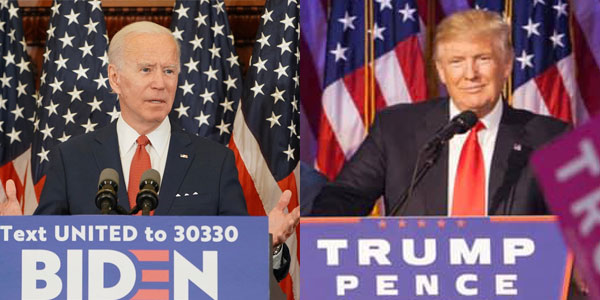
Joe Biden and Donald Trump
This guest column is part of Citizens Union Speakers, a regular series of op-eds written by members of the Citizens Union Foundation community in Gotham Gazette, CUF's flagship public education program. The opinions expressed in these Citizens Union Speakers columns are those of the authors alone, not Citizens Union Foundation, Gotham Gazette, or any other entity.
* * * * * * * * * * * * * * * * * * * *
For more than 120 years, Citizens Union has been a non-partisan force for transparency, accountability, honesty, and ethics in New York City and State government.
Founded by private citizens who cared about good government and wanted to call out the corrupt political bosses of the Tammany Hall era, Citizens Union has since made an essential part of its mission to express preferences for state and local candidates who share its values. It's a kind of non-partisan Good Housekeeping "seal of approval" highly coveted by those seeking elected office in New York.
But never before have we expressed a preference in a U.S. Presidential race. That is, until now.
For the first time in our century-and-a-quarter history, Citizens Union's board has decided that the stakes in this year's Presidential race are too high -- for New Yorkers and all Americans -- to sit on the sidelines.
Whether to do so was the subject of intense board debate. After all, we were considering whether to do something unprecedented for our organization -- weigh in on a federal race -- when our focus has always been on local and state government. At the end of a lengthy debate, however, our board voted overwhelmingly, with many of us considering this to be the most consequential Presidential race of our lifetimes. But we also committed to follow our customary practice, reaching out to campaigns with questions, affording them the opportunity to be heard by screening committees, and ultimately having the Board vote on a preference, which will come later, before the November election.
How did we get here? I have had the honor of chairing Citizens Union's board for the past four years. And with each year during the Trump Administration, we have found ourselves increasingly having to speak out on federal issues affecting New York -- also a rare, if not unprecedented occurrence for our organization.
First, in August 2017, we felt compelled to denounce President Trump's characterization of white supremacists and neo-Nazis inciting violence in Charlottesville, Virginia, as "very good people." In the face of their threats to come to New York City, we said "there is no place for them here in New York," and we called the President's comments "repugnant," "reprehensible" and "wrong."
Next, in June 2018, we called out our federal government's "dysfunctional immigration policy" affecting so many in New York City. And we condemned "the appalling lack of leadership" in countenancing "helpless infants" being "stripped from their mothers' arms at the border and then held, traumatized, in make-shift internment camps."
Then, in October 2019, we spoke out again about the President's attempts to discredit and "out" the whistleblower who first reported the Ukrainian incident that resulted in Trump's impeachment. We noted our organization's long-standing support of whistleblower protections, said of impeachment that "such an inquiry is not -- as President Trump claims -- a 'hoax' or a 'coup,'" and urged Trump to stop seeking to "erode public confidence in our democratic institutions."
And most recently, last month, we once again felt compelled to speak out -- this time about the President's mishandling of two crises (coronavirus and racial justice) that have rocked New York and the nation. We concluded: "The true measure of a leader is one who inspires us to be the best version of ourselves and treat each other with equality, dignity and respect. Now is a time when we crave such leadership."
Now, our nation is at a crossroads. And the issues that Citizens Union cares most about -- transparency, accountability, honesty, and ethics in government -- will be front and center in this year's Presidential race. And Citizens Union will be there, speaking out, expressing its preference, and holding the candidates accountable to show they can lead us through these troubling times.
***
Randy Mastro is the Chair of Citizens Union and Citizens Union Foundation, a former New York City Deputy Mayor, and a current partner at Gibson Dunn & Crutcher LLP.
***
Have an op-ed idea or submission for Gotham Gazette? Email This email address is being protected from spambots. You need JavaScript enabled to view it.
***
This guest column is part of Citizens Union Speakers, a regular series of op-eds written by members of the Citizens Union Foundation community in Gotham Gazette, CUF's flagship public education program. The opinions expressed in these Citizens Union Speakers columns are those of the authors alone, not Citizens Union Foundation, Gotham Gazette, or any other entity.
* * * * * * * * * * * * * * * * * * * *
The Time Has Come to Repeal Section 50-A of New York’s Civil Rights Law
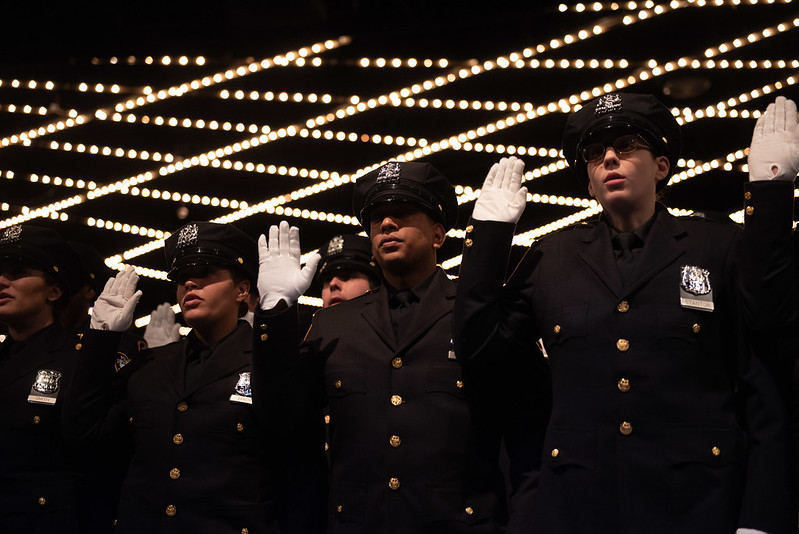
Police officers take the oath (photo: Michael Appleton/Mayor's Office)
This guest column is part of Citizens Union Speakers, a regular series of op-eds written by members of the Citizens Union Foundation community in Gotham Gazette, CUF's flagship public education program. The opinions expressed in these Citizens Union Speakers columns are those of the authors alone, not Citizens Union Foundation, Gotham Gazette, or any other entity.
* * * * * * * * * * * * * * * * * * * *
In light of the police killing of George Floyd, Governor Cuomo has announced that he would support “reform” of Section 50-a of the Civil Rights Law, which prevents disclosure of any documents relating to the disciplinary records of police officers. The Governor has not indicated what “reform” he prefers, but he subsequently said, referring to the Legislature, that whether “repeal, reform, whatever they send me I will sign.” The Legislature should repeal the law in its entirety as an important step toward greater police accountability.
Section 50-a, which was enacted in 1976, provides that “[a]ll personnel records used to evaluate performance toward continued employment or promotion” of a police officer “shall be considered confidential and not subject to inspection or review without the express written consent of such police officer...except as may be mandated by lawful court order.”
The statute goes on to provide that prior to issuing such court order, a judge must review all such requests and give interested parties the opportunity to be heard and then review the requested records under seal in order to determine whether they are relevant and material to the action before him or her. The provision for a court order applies only to a pending litigation in which a party seeks a subpoena for documents covered by Section 50-a, not to a request under the Freedom of Information Law (FOIL).
Indeed, New York’s highest court has ruled that Section 50-a prohibits any disclosure of disciplinary records under FOIL (see New York Civil Liberties Union v. New York City Police Department, 32 N.Y.3d 556 (2018); and Daily Gazette v. Schenectady, 93 N.Y.2d 145, 154-55 (1999)). Section 50-a would also appear to prohibit voluntary disclosure of such records by police departments, at least where they identify particular officers.
The effect of Section 50-a is to significantly deprive the public of information necessary to ensure the accountability of police officers for misconduct and of the Police Department for ensuring such accountability through its systems of civilian complaints and disciplinary proceedings. Without information as to the outcome of such proceedings, it is impossible to know if those systems are functioning properly.
The extent to which the confidentiality of police disciplinary records may have kept the public in the dark about significant wrongdoing and the absence of an adequate response is presented dramatically in the results of an examination of 319 files from 2011 to 2015 published by BuzzFeed News in 2018, “Secret NYPD Files: Officers Can Lie And Brutally Beat People – And Still Keep Their Jobs.” For a more dispassionate, statistical analysis and critique, see the Nineteenth Annual Report of the New York City Commission to Combat Police Corruption, published in December 2019 (pp. 37-116).
At the urging of Citizens Union, where I sat on the Board of Directors, the NYPD and the Civilian Complaint Review Board (CCRB) entered into a Memorandum of Understanding in 2012 in which the Police Department authorized the CCRB to undertake all administrative prosecutions of civilian complaints against police officers that have been substantiated by the CCRB and in which the CCRB has recommended that charges and specifications be preferred.
The MOU further provides that in any case substantiated by the CCRB in which the Police Commissioner intends to impose discipline that is of a lower level than that recommended by the CCRB or by an NYPD Trial Commissioner, the Police Commissioner shall send the CCRB a detailed, written explanation of the reasons for deviating from that recommendation, including each factor the Police Commissioner considered in making the decision. In light of the position of the Police Department that all disciplinary records are confidential under Section 50-a, we and all other watchdogs and interested parties are unable to monitor compliance with this provision.
It has been argued that Section 50-a is justified by the need to protect police officers against harassment or retaliation resulting from disclosure of disciplinary records. However, notwithstanding the law, until 2016 (40 years after its enactment), the New York City Police Department made public the records of disciplinary proceedings against police officers resulting in a substantiation of the complaint. There appears to be no evidence that that practice resulted in any harm to police officers.
It has also been argued in support of “reform” of Section 50-a, as opposed to repeal, that it is unfair to police officers for there to be public disclosure of records pertaining to unsubstantiated complaints or charges against them. However, police officers, like other public officials and employees, already enjoy significant (if not absolute) protection against such disclosure. FOIL exempts from its requirements records the disclosure of which would constitute an unwarranted invasion of personal privacy (see Public Officers Law §§ 87(2)(b) and 89(2)(b)).
The Committee on Open Government has issued two advisory opinions stating that the personal privacy exemption is applicable when allegations or charges of misconduct have not yet been determined or did not result in disciplinary action (see FOIL AO-10399 (Oct. 31, 1997) (police officers)) or when allegations of misconduct were not substantiated (see FOIL AO-12005 (Mar. 21, 2000) (prison inmates)).
Although the Advisory Opinions of the Committee on Open Government “are not binding authority, they may be considered on the strength of their reasoning and analysis” (see Matter of TJS of N.Y., Inc. v. New York State Dep’t of Taxation & Fin., 89 A.D.3d 239, 242 n.1 (3d Dep’t 2011)). The reasoning of the advisory opinions cited above appears correct at least with respect to documents that reveal the identity of the individuals against whom the unsubstantiated complaints were made.
That is not to say that FOIL would never require disclosure of documents relating to unsubstantiated reports of misconduct or that such disclosure would always be inappropriate. For one thing, statistical tabulations and other data that do not reveal the identity of the police officer are necessary for accountability and should be permitted. In addition, in a high-profile case in which the nature of the complaint and the name of the police officer are already a matter of public knowledge, and where there is controversy surrounding the adequacy of the investigation, the appropriate balance between the public interest in the matter and the privacy interest of the police officer should tip in favor of disclosure. It is precisely that kind of careful weighing of factors by a court that FOIL mandates, and Section 50-a precludes.
In sum, police officers should enjoy the same level of protection as provided to all government officials under the exemptions to FOIL. Indeed, New York is one of only two states that grant police officers special privacy protections beyond what other public employees have. Accordingly, the Legislature should repeal Section 50-a in its entirety.
***
Frederick P. Schaffer is a Director of Citizens Union Foundation.
***
Have an op-ed idea or submission for Gotham Gazette? Email This email address is being protected from spambots. You need JavaScript enabled to view it.
***
This guest column is part of Citizens Union Speakers, a regular series of op-eds written by members of the Citizens Union Foundation community in Gotham Gazette, CUF's flagship public education program. The opinions expressed in these Citizens Union Speakers columns are those of the authors alone, not Citizens Union Foundation, Gotham Gazette, or any other entity.
* * * * * * * * * * * * * * * * * * * *

|
Tweet |