Max Politics Podcast: Ron Kim on How Democrats Can Win Back Asian Voters
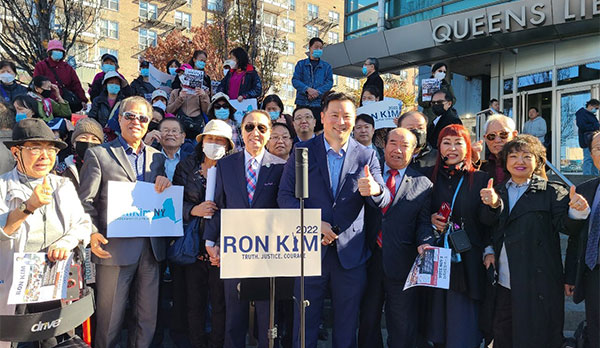
Assemblymember Ron Kim (photo: @rontkim)
November 30, 2022 - Max Politics Podcast: Ron Kim on How Democrats Can Win Back Asian Voters
Queens Assemblymember Ron Kim, fresh off a narrow reelection win, joined the show to discuss how Democrats can win back Asian voters who have been moving toward Republicans in recent election cycles, what's wrong with the Democratic Party in New York, and more.
Listen to the conversation and let us know what you think, on Twitter @TweetBenMax. You can listen to the show through the embedded audio below or download the episode wherever you get your podcasts at Max Politics.
***
by Ben Max, Gotham Gazette
@tweetBenMax @GothamGazette
'I knew the vote would be close, but I didn't think that close': Iwen Chu's History-Making Win in Brooklyn's New 17th State Senate District
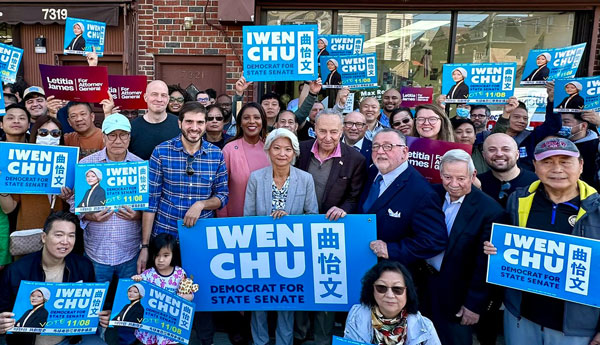
A rally for Iwen Chu, center (photo: @Iwen4NY)
This month, Iwen Chu became the first Asian-American woman elected to the New York State Senate, clinching an unexpectedly tight victory over Republican Vito LaBella. Starting in January, Chu will represent the 17th Senate District, a newly-created Asian-plurality district in Southern Brooklyn, redrawn in the recent redistricting process based on demographic trends in the 2020 Census, which saw Asian Americans as the fastest growing group in New York in the last ten years.
Chu’s victory was hard fought, with a margin of just 215 votes as of November 21, and though going into the election she was expected to win fairly easily, she wound up defying the political headwinds by significantly outperforming the top of the Democratic ticket in neighborhoods that have been increasingly leaning towards Republicans over the last few years.
The new 17th District, one of 63 Senate seats across the state, includes parts of Sunset Park, Bensonhurst, Bath Beach, Bay Ridge, Kensington, and Dyker Heights, with a population that is 48.6% Asian, 29.3% white, and 18% Hispanic according to the CUNY Graduate Center’s Redistricting and You project.
The district is home to 69,884 registered Democrats, 18,645 Republicans, and 40,182 party-unaffiliated registered voters, according to State Board of Elections data as of November 1. Even though Democrat Joe Biden won what is now the district by nearly 17 points over Republican President Donald Trump in the high turnout 2020 election, the district has been growing redder in other races, like for mayor and city and state legislative seats.
As was readily apparent from this and past elections, portions of Southern Brooklyn are unlike much of the rest of the heavily Democratic borough. In the 2021 mayoral race, Republican nominee Curtis Sliwa carried much of the region over Eric Adams, and in this election, Republicans won three Assembly seats, unseating incumbent Democrats.
In this year’s election, not only did Hochul win by a far narrower margin than the Democratic gubernatorial nominee in the last four elections, but Democrats sustained significant defeats in Southern Brooklyn, on Long Island, and in the Hudson Valley. And though U.S. Rep. Lee Zeldin, the Republican nominee for governor, lost in all of Brooklyn to Governor Kathy Hochul by a margin of 28.3% to 70.8%, he handily won in Southern Brooklyn.
The new 17th State Senate districts overlaps significantly with the smaller Assembly districts 47, 49, and 51, and slivers of Assembly Districts 44, 45, 46, and 64.
Assembly Districts 47 and 49 cover the vast majority of Senate District 17 and include the neighborhoods of Bensonhurst, with its large Asian-American population, Bath Beach, New Utrecht, and parts of Bay Ridge and Dyker Heights. Zeldin bested Hochul with 62% and 63% of the vote in those two Assembly districts, respectively. LaBella won those Assembly districts with smaller margins, 55% and 52% of the vote, respectively, meaning Chu was able to outrun Hochul by 7 and 11 points. However, in Assembly District 51, which covers Sunset Park and Red Hook, home to large Asian and Hispanic communities, Hochul won with 76.4% of the vote. Parts of that district in Sunset Park fall within the new Senate district and Chu won there with 71% of the vote, in essence providing her narrow overall margin of victory.
Asian voters in Southern Brooklyn and parts of Queens have been voting more Republican in recent election cycles, and Chu had to win over many of them that were voting for Zeldin for governor in order to win her Senate race.
Chu did have her advantages over LaBella, a former NYPD officer and education activist. She has long been involved in the local political arena, as a member of Community Board 11, a member of Community Education Council District 20, and most recently as former chief of staff to longtime Assemblymember Peter Abbate (who was among the Democratic incumbents defeated this year). Chu ran unopposed in the primary for the new open seat and was able to quickly garner widespread support from the Democratic political establishment, progressive groups, elected officials, political clubs, and labor unions across Brooklyn and beyond into the general election.
Chu’s policy platform was comparable in parts to her opponent’s. “I believe education and public safety is not a party position. That's why even my opponent and I, on these two issues, we are very similar,” she said in a Monday interview. Chu supported changes to the state’s controversial bail laws to give judges more discretion in setting bail though LaBella’s positions went further – he was pushing for entirely reversing the state’s bail reforms, which eliminated cash bail for most nonviolent offenses.
Both Chu and LaBella opposed efforts to replace gifted and talented programs in city schools and to drastically change admissions at the city's elite Specialized High Schools, issues that are particularly important to Asian American communities and on which Democrats have found themselves split.
Chu also advocated for increased social services to tackle the root causes of crime, greater support for small businesses, including loans, grants, and language assistance programs, increased resources for immigrant communities including legal assistance and poll site interpretation services, investments in street safety improvements, and increased affordable housing support.
LaBella, meanwhile, also said he would push the governor to audit and fire any district attorneys who refuse to enforce the law, echoing a call from Republicans aimed specifically at Manhattan District Attorney Alvin Bragg, a reform-minded Democrat. LaBella also railed against Critical Race Theory, though it isn’t taught in city schools. In September, he landed in hot water after the New York Daily News reported on a video he posted last year from his summer home in Massachusetts, in which he said, “I just like it so much better here than Brooklyn. I hate fucking Brooklyn, I wish I never had to go back.”
Though Chu, as a longtime participant in local politics and an Asian-American woman, had a ready constituency clamoring for representation in state government, she knew the challenge she faced, having taken stock of the 2021 mayoral election. “We cannot afford to leave any stone unturned!,” she tweeted ahead of the election along with images of two maps showing how Sliwa performed well in the 2021 election alongside the contours of the new Senate district. She called for help from Democrats to ensure the seat would be theirs.
“I knew the vote would be close, but I didn't think that close,” Chu said in the Monday interview.
The issues that resonated with voters in the new 17th State Senate District were similar to those that Sliwa pounced on to win broad parts of the area: concerns about public safety, including rising anti-Asian hate crimes, and education, specifically preserving gifted and talented programs and test-based admissions to the city’s specialized high schools.
“Safety concerns, it's definitely the number one topic no matter what language you speak or what background you're from. Everybody wants to feel safe,” Chu said.
Some Democrats have long recognized that Southern Brooklyn voters go their own way and the Democrats there tend not to vote strictly along party lines. “We’ve never had blowout elections in Southern Brooklyn,” said State Senator Andrew Gounardes, a Democrat whose current, outgoing district covered many of the neighborhoods of the new 17th. Gounardes himself flipped a seat from Republican to Democrat in the ‘blue wave’ 2018 elections.
Gounardes placed no small amount of blame for losses and close calls on the state and county Democratic parties, which took a hands-off approach to the election that has incensed Democrats across the borough, city, state, and even country.
“This election cycle, I didn't see a single bit of effort from the state party to invest in Southern Brooklyn. I didn't see any effort…barely an effort from the county party to help in southern Brooklyn,” he said of the Brooklyn Democratic Party, which has been accused of failing to support its candidates while blaming them for their own defeats.
Gounardes worries that without constant effort and attention from the party apparatus, “we will lose these neighborhoods for good. And I’m very concerned about that. because we have worked so hard to move the needle so far. And to see this work now being undone because we can't get the parties to pay attention is very disappointing.”
“In the most Democratic county in the country, we should not be losing Democratic incumbents when the top of our ticket is winning,” he added.
City Council Member Justin Brannan, a Bay Ridge Democrat who also narrowly won reelection last year, echoed Gounardes. “Southern Brooklyn has always been unique and complicated and often misunderstood or taken for granted,” he said. “Every cycle people seem to have amnesia about how close the general elections are in Southern Brooklyn and I certainly don’t enjoy saying, ‘I told you so’ but this is something that we've been sounding the alarm on for quite a while. The Democratic Party has all but completely lost large portions of voters in Southern Brooklyn who are now reliably voting Republican.”
What most people agree on is that Democrats lost the rhetorical battle to Republicans on the issue of crime and public safety. Republicans repeatedly hammered away at rising crime rates, blaming Democratic policies for what they depicted as an out of control city and state, especially honing in on rising hate crimes against the Asian community. That message was largely consistent from local races up to the statewide level.
“Campaign strategy-wise, Republicans, they do organize, they do,” Chu said. “Obviously, the voters took the message and then they sent the message to us loud and clear. Mainstream [Democrats], we didn't address Southern Brooklyn voters strong enough.”
“There was a well-funded Republican campaign that highlighted crime that certainly drove Republican votes in Southern Brooklyn,” said one Democratic consultant who wished to remain anonymous to speak more freely. “There was an effective messaging campaign by Republicans, whether it's fair or whether it's accurate is a different question…It's something that Democrats gotta figure out going forward to 2023 Council elections, 2024 legislative elections.”
Brannan conceded that his party did not offer a positive vision that could oppose Republican fearmongering that peeled away a significant chunk of voters, particularly amid the sustained pandemic era increases in most major crimes. “We're losing to an opposition who has zero solutions,” he said. “We're losing to an opposition who was just pointing at things and saying that's a problem. But our party is not countering that with anything. We're not articulating a vision to counter that ‘world is going to hell’ narrative.”
“The Democratic Party has to give more to the community than identity politics,” said George Sarantopoulos, who co-managed LaBella’s campaign with his wife, Heidi Chan-Sarantopoulos. “I think people are concerned in the district about crime. They're concerned about cost of living…They're worried about getting to work every day and going on the subway and getting robbed on the way coming back from work.”
Sarantopoulos said it was natural that Chu would have significant support from Asian New Yorkers, particularly as she pitched herself becoming the first Asian-American woman to be elected to the Senate. But Asian Americans also came out in support of LaBella, who is white, he said. “Obviously, our message resonated with a large portion of the Chinese community…I saw that in terms of voters, in terms of volunteers. Vito LaBella was embraced by a good portion of the community.”
One of the issues on which Democrats have lost ground to Republicans is specialized high schools and gifted and talented programs. Former Mayor Bill de Blasio sought to replace G&T programs with a universal enrichment model and change admissions policies at the specialized high schools to increase enrollment of Black and Hispanic students, earning the ire of many Asian Americans. That backlash was felt at the polls last year and has continued into this year’s election, even though many Democrats did not support de Blasio’s efforts. “I think the gifted and talented programs and specialized high schools are not up for negotiation...It’s a deal-breaker for the Chinese community,” Sarantopoulos said.
Chu said that the conversation around changing specialized high school admissions, which became a major focus for de Blasio in 2017, eroded “faith and trust about how the city government is serving us,” not just for Asian-American families but other immigrant communities in the district that see education as a crucial pathway for the next generation. “We need to prove to those voters…that not all Democrats are saying the same thing,” she said.
While Mayor Adams reversed de Blasio’s plan to replace G&T programs and even announced plans to expand on the current model, while also announcing opposition to changing specialized high school admissions and plans to open new specialized high schools, Republicans still successfully painted Democrats as a threat to the educational opportunities that many Asian New Yorkers prioritize.
What was also clear from the election is that while the state and Brooklyn Democratic parties failed to step in, Governor Hochul ran an anemic campaign in Southern Brooklyn. “There were definitely a lot of voters in WeChat that supported just Republican candidates in general…very much unhappy with the current incumbent Democrat,” said Yiatin Chu, president of the Asian Wave Alliance, a group that endorsed both Republican and Democratic candidates in the election but favored the GOP. Yiatin Chu (no relation to Iwen Chu) is a close personal friend of LaBella and volunteered on his campaign.
Yiatin Chu and the Asian Wave Alliance focused heavily on the issues of public safety and education, and on Asian turnout for many Republicans in the 2022 elections, from Zeldin to LaBella, as well as victorious or nearly-victorious Assembly candidates in Brooklyn and Queens.
In Southern Brooklyn, Republican Lester Chang defeated longtime incumbent Democratic Assemblymember Abbate in the 49th District (though there are questions about Chang’s residency that could endanger his victory); Democratic Assemblymember Steven Cymbrowitz lost to Republican challenger Michael Novakhov in the 45th District; and in District 46, incumbent Democratic Assemblymember Mathylde Frontus lost to her Republican opponent, Alec Brook-Krasny. In Flushing, Queens Assemblymember Ron Kim, a Democrat, won his reelection by a margin of less than four points in a district that Zeldin narrowly carried against Hochul. And in Rockaway, Democrat Assemblymember Stacey Pheffer Amato trails in her race by 246 votes.
Even the newly minted state senator conceded that Democrats have failed to pay attention to issues that voters in the district have raised, particularly around public safety and changes to education systems. “We're the voice of the district. We represent the people. So I need to make sure my colleagues in the State Senate, in Albany, in government, they need to understand Southern Brooklyn here, we’ve been ignored far too long,” Iwen Chu said.
Yiatin Chu said that key to Iwen Chu’s victory was her securing votes from many reliably Democratic voters, particularly outside the Chinese community. “But in terms of the unaffiliated, kind of the everyday parents, small business owners. They were not excited about her,” Yiatin Chu said. “It's kind of like the excitement for the first Asian woman in the Senate all came from outside the communities that she was running in.”
The political battle for the new 17th State Senate District has just begun. Iwen Chu and Democrats now have two years till the next election to prove to constituents that the party has their best interests in mind and solutions to their woes.
“We understand how the pandemic affected a lot of small businesses, immigrant businesses, how the pandemic increased a lot of Asian hate crime so that anyone in Southern Brooklyn who is Asian American, either directly themselves or someone they know has had a bad experience,” said Jay Brown, vice president of Bay Ridge Democrats, which endorsed Chu’s campaign. “So our side has plans to tackle those issues, and Iwen does, but that’s a nuanced conversation sometimes, how to attack those problems in a positive way.”
“It's a lot easier to just kind of tout crime and instill fear. That's a quick and easy thing to do,” Brown said. “And it resonates with people because they feel it. So we knew that was a hurdle to overcome. And we've been seeing that the past few years that that's been, reverberating throughout the communities a bit.”
***
by Samar Khurshid, senior reporter, Gotham Gazette
@samarkhurshid @GothamGazette
Despite State Budget Funding, Little Progress Bringing Psychiatric Beds Back Into Service
Hospital staff (photo: Michael Appleton/Mayoral Photography Office)
New York State has made little progress bringing 1,000 shuttered psychiatric beds back into service after they were closed during the covid pandemic, raising questions about a signature element of the mental health and public safety agendas of Governor Kathy Hochul and Mayor Eric Adams.
In the April budget, Hochul and the Legislature allocated $27.5 million in state funding, matched by federal dollars, to restore the roughly 1,050 psychiatric beds shifted at the height of the pandemic when hospitals scrambled to make room for the swell of COVID-19 patients. Since then, only about 200 psychiatric beds have come back into use, according to the state Office of Mental Health (OMH) – a number that has not moved since June. OMH did not provide a breakdown of where the 200 beds are located.
According to OMH, nearly half the 850 defunct psychiatric beds are in New York City, where 415 remained offline as of September. Another 435 of the beds are closed outside the city, including 94 on Long Island, 141 in the "Hudson River Region," 61 in Central New York, and 139 in the western part of the state. There are currently roughly 5,800 licensed psychiatric beds in 97 hospitals across the state, and 3,300 more in New York's state-run psychiatric hospitals.
The state expects New York City to add another 200 psychiatric beds "in the coming months," according to the Office of Mental Health. In response to Gotham Gazette inquiries, the governor's office did not comment on the apparent lack of progress since June.
The beds have been central to the street safety plans Hochul and Adams have touted since January, policies aimed at beefing up police and mental health services, particularly underground, amid a string of high profile attacks committed by people with reported psychosis. According to the two leaders, psychiatric beds are a complement to their efforts to flood the city's public spaces with police officers, and to a lesser extent social workers – offering a helpful destination for those in severe need, who have often wound up on the streets and subways or in jail.
Part of a larger formula backed by and enacted in partnership with Mayor Adams, the psychiatric beds were announced alongside increased police and outreach worker patrols. In the state budget deal of April Hochul also toughened the state's bail and discovery laws and expanded Kendra's Law – a statute that enables officials to obtain court-ordered outpatient mental health treatment.
When announcing the state budget agreement on April 9, Hochul said, "There's an obligation on our part to not just make those kinds of changes, but to balance the other side of the equation as well. Invest in resources for those who need it most. Invest in the mental health structure infrastructure to give people what they need."
"We are going to make sure that there are over 1,000 psychiatric beds available because there are people that need care, they need attention, they need to be on a path to recovery," Hochul continued. "And they can't get it as long as there's beds that are not available in a place that can be helpful to them."
The psychiatric beds had been part of Adams' broader state budget ask when he testified before the Legislature in February, just before releasing his own preliminary budget.
"It is urgent that we request the state’s immediate assistance in expanding the number of beds for those in critical need of mental health care, and funding for the medical and support staff they require," Adams told state lawmakers in February.
"Too many of our fellow New Yorkers are cycled through temporary care and released before they are ready, often due to the limited availability of long-term support and housing," he testified.
"That's crucial for us," Adams had said of restoring the psychiatric beds when he made his preliminary budget announcement in February, which included more funding for police officers and homeless-encampment clearing.
"We're ending the era of tents. We're ending the era of sleeping on our subway system, with all your belongings, that era has ended in the city," Adams said. "But at the same time, we want to have additional help and giving people the mental help that they need."
The $55 million total state and federal allocation would fund higher Medicaid reimbursement rates for psychiatric beds that would bring them to the same levels as general medical beds.
"Let's make up that differential," Hochul said at another subway safety announcement with Adams in October. "That's what our money from the state went towards. So there's not an incentive to have fewer psychiatric beds."
But the higher reimbursement rates require federal approval, which is still pending, according to James Plastiras, a spokesperson for the state’s Office of Mental Health. None of the state allocation has been spent as of early November, meaning 200 psychiatric beds were restored at the existing Medicaid rate. Plastiras told Gotham Gazette the higher Medicaid reimbursement rates will be retroactive to April 1 once they receive federal approval.
“Under Governor Hochul’s leadership, we are fully committed to providing a comprehensive array of services for any New Yorker experiencing a mental health crisis — including the unhoused," Plastiras wrote in a statement to Gotham Gazette.
"We are embracing innovative approaches to help these individuals address their mental health issues in meaningful ways that will allow them to transition into stable housing in independent settings," he said, noting investments in community-based mental health services and a $12.5 million budget allocation to add 500 scatter-site supportive units, which include on-site services, to the state's housing portfolio.
As of October, the state had not issued a request for proposals to initiate the supportive housing development, which includes services to support formerly-homeless individuals. According to Plastiras, one would be issued by the end of the year.
The state was also slow to complete the rollout of Hochul's Safe Option Support outreach teams, part of her first subway safety announcement with Adams in January, and it is unclear whether they have been effective in helping homeless individuals into permanent housing (after this article was published Plastiras told Gotham Gazette the teams have enrolled 500 individuals in some kind of service). And despite amending Kendra's Law, the new language was not used as the basis of any court orders in its first four months in effect, raising questions about implementation across the state.
It is not a simple matter to open a psychiatric bed in a hospital. It requires unique configurations of space and staff. In the case of repurposing medical beds, there can be construction costs and capital needs to make them safe and appropriate for psychiatric patients.
"All of this stuff they built into these rooms to take care of the [COVID-19] medical emergency needs to be undone," said Alison Burke, the vice president of regulatory and professional affairs at the Greater New York Hospital Association, which represents 280 member hospitals, in an interview.
Hospitals are also contending with staffing shortages that have become drastic during the pandemic. The state budget allocated another $9 million to recruit psychiatrists and psychiatric nurse practitioners with loan forgiveness. After a series of Gotham Gazette inquiries for this story, the governor’s office put out a press release on Wednesday, November 23 announcing the opening of applications for the program.
"Community-based mental health care providers continue to be impacted by the nationwide shortage of healthcare workers, and the demand for psychiatrists and psychiatric nurse practitioners continues to grow,” said New York State Office of Mental Health Commissioner Dr. Ann Sullivan, in the press release. “The Community Mental Health Loan Repayment Program will help our partners meet this growing demand by helping to attract and retain these essential professionals."
"We're confounded by the fact that we have workforce challenges," Burke of Greater New York Hospital Association told Gotham Gazette.
The commitments to higher Medicaid rates and staffing retention were welcome to hospitals, even if they have been slow to materialize. "We're moving in the right direction. It's a very welcome and necessary investment," Burke said.
As pandemic era crime increases came to define the 2022 election, as they had 2021 races in New York, Hochul emphasized the mental health funding she secured in the state budget alongside changes to the state's bail and outpatient treatment laws. In October, she joined Adams, and the heads of OMH, the MTA, and the NYPD to announce another phase in their subway safety strategy that she dubbed, "Cops, Cameras, and Care."
The plan included dispatching 1,200 more police officers to subways, installing surveillance cameras in every subway car, and opening up 50 new psychiatric beds, dedicated to homeless individuals with severe mental illnesses. Even with ridership up, Hochul, Adams, and their appointees said the public perception of danger is high, driven by unstable passengers and fare-beaters who they claim have a propensity for more serious offenses.
"It's not just stats. We can give you stats all day. The question is how do New Yorkers feel? We must match the actual impacts with how New Yorkers feel on the streets and in the subway system," Adams said.
"That's why the omnipresence of police officers and the removal of those who are dealing with mental health issues is crucial to our second phase of this important plan," the mayor said.
Asked to respond to the halting restoration of psychiatric beds despite the state budget allocation and promise of 1,050 beds back into service, a spokesperson for Adams referred Gotham Gazette to the city's Department of Health and Mental Hygiene (DOHMH).
"All of us – federal, state, city and service providers – are working day and night to improve our system of care for people living with mental illness. We are introducing new and innovative strategies to ensure that we can overcome decades of underinvestment and neglect to meet the incredible needs of the moment," DOHMH spokesperson Patrick Gallahue said by email.
The 50 psychiatric beds are separate from the 1,000 accounted for in the state budget, funded with $10 million from the state's general fund, Crain's New York reported. The first of two new 25-bed "Transition to Home" units opened on November 1 at the Manhattan Psychiatric Center, according to OMH. The office also plans to seek contract bids for a $7.3 million residential step-down program that will offer short-term housing with services to help individuals transition to more independent living.
At the time of the announcement, Adams said the NYPD had removed 1,500 "emotionally disturbed persons" from the subway during the calendar year "to prevent some form of incident from taking place." It is unclear whether those individuals were charged with a crime or where they ended up; a series of city agencies did not respond to inquiries other than to refer Gotham Gazette to another city agency.
***
by Ethan Geringer-Sameth, reporter, Gotham Gazette
@GeringerSameth @GothamGazette

|
Tweet |